
Departmental Results Report 2016-17
Archived information
Archived information is provided for reference, research or record-keeping purposes. It is not subject to Government of Canada web standards and has not been altered or updated since it was archived. Contact us to request a format other than those available.
The Honourable Kirsty Duncan, P.C., M.P.
Minister of Science
© Her Majesty the Queen in Right of Canada,
represented by the Minister of Industry, 2017
Cat. No. CR1-16E
ISSN 2561-1895
Table of Contents
Raison d’être, mandate and role: who we are and what we do
Operating context and key risks
- Programs
- Program 1.1: Talent: attraction, retention and development of students and researchers in the social sciences and humanities
- Program 1.2: Insight: new knowledge in the social sciences and humanities
- Program 1.3: Connection: mobilization of social sciences and humanities knowledge
- Program 2.1: Indirect costs of research
- Program 2.2: Canada First Research Excellence Fund
- Internal Services
Analysis of trends in spending and human resources
- Actual expenditures
- Actual human resources
- Expenditures by vote
- Alignment of spending with the whole-of-government framework
- Financial statements and financial statements highlights
- Corporate information
- Supporting information on lower-level programs
- Supplementary information tables
- Federal tax expenditures
- Organizational contact information
Minister’s message
I am pleased to report progress made on making Canada a world-leading centre for innovation and science, helping create good, well-paying jobs, and strengthening and growing the middle class.
The work of the Innovation, Science and Economic Development Portfolio includes promoting innovation and science; supporting the commercialization of more research and ideas; providing more Canadians with the skills to participate in a global and digital economy; helping small businesses grow through innovation, access to capital and trade; promoting increased tourism in Canada; and supporting scientific research and the integration of scientific considerations in our investment and policy choices.
This year, the Portfolio organizations continued their work to deliver on the Government’s Budget 2017 commitment to develop an Innovation and Skills Plan. The plan’s focus on people and addressing the changing nature of the economy is a focus for the Portfolio’s programs.
The programs of the Social Sciences and Humanities Research Council (SSHRC) are central to delivering Canada’s Innovation and Skills Plan. Through its support for researchers and students in the humanities and sciences, SSHRC helps train the next generation of innovative thinkers, and supports the contribution of scholarly research in policy-making, to benefit all Canadians.
It is my pleasure to present the 2016–17 Departmental Results Report for SSHRC.

The Honourable Kirsty Duncan
Minister of Science
Institutional Head’s message
I am pleased to present the Social Sciences and Humanities Research Council’s (SSHRC) 2016-17 Departmental Results Report. The report outlines our progress in meeting the commitments in our 2016-17 Report on Plans and Priorities. These efforts have been guided by SSHRC’s 2016-20 strategic plan, which, informed by the Government of Canada’s overarching mission, focuses squarely on 3 priorities: enabling excellence, creating opportunities for research and research training through collaboration, and connecting research with Canadians.
In implementing the strategic plan this year, SSHRC worked in pursuit of a number of activities designed to position social sciences and humanities research as a key force supporting informed, evidence-based decision-making; stimulating creativity; and accelerating innovation, to the benefit of all Canadians. The Imagining Canada’s Future initiative, for example, continued to guide discussion and to mobilize research to address the challenges of today and tomorrow, whether through efforts to ensure a successful shared future for and with Indigenous peoples; sustainably manage our energy and natural resources; or better position Canada in the evolving geopolitical landscape. Internationally, SSHRC collaborated with funding partners in Europe and the Americas to assist Canadian researchers and their partners abroad to investigate ways to benefit from big data. In addition, a new agreement with the European Research Council gives Canada Research Chairs and Banting Postdoctoral Fellows across all disciplines the opportunity to collaborate with top European research teams to lead innovation.
Improvements to its funding programs and client services allow SSHRC to serve Canada’s research community with greater effectiveness, efficiency and accountability. New Partnership Engage Grants offer short-term, timely support for cross-sector collaborative research directly informing decision-making in public, private or not-for-profit organizations. Increased responsiveness and adaptability in our Connection Grants funding opportunity better connect existing research with those able to apply its results to improve the lives of Canadians.
Moving forward, SSHRC will continue to deliver strongly on its mandate to promote and support excellence in humanities and social sciences research, and to provide advice to government and, indeed, all Canadians. In doing so, SSHRC will continue to maintain and enhance Canada’s position as a global leader in knowledge generation and dissemination.

Ted Hewitt
President, Social Sciences and Humanities Research Council
Results at a glance
What funds were used? (2016–17 actual spending) |
Who was involved? (2016–17 actual full-time equivalents [FTEs]) |
|---|---|
| $775,954,048 | 228 |
Results Highlights
- In April 2016, SSHRC released its 2016-20 strategic plan, Advancing Knowledge for Canada’s FutureFootnote 1, which outlined its strategic goal of sustaining and positioning Canada as a global leader in humanities and social sciences research and research training. To realize this goal, SSHRC identified three strategic objectives to guide its activities through to 2020: enable excellence in a changing research landscape; create opportunities for research and training through collaborative initiatives; and connect social sciences and humanities research with Canadians.
Enable excellence in a changing research landscape
- Throughout 2016-17, SSHRC continued its engagement on whole-of-government issues related to science policy, including support for the Innovation and Skills Plan, Open Government initiatives, and Canada’s Fundamental Science ReviewFootnote 2. SSHRC supported the government’s commitments to Open Science through the launch of the Tri-Agency Statement of Principles on Digital Data ManagementFootnote 3, its ongoing support for the Tri-Agency Open Access Policy on PublicationsFootnote 4, and its participation in the committee developing an Open Science implementation plan for the Government of Canada.
- In 2016-17, SSHRC continued with the ongoing development of its Aboriginal Research Integrated StrategyFootnote 5 and activities related to the Truth and Reconciliation Commission of Canada’s calls to action Footnote 6. SSHRC also developed a new funding opportunity, Partnership Engage GrantsFootnote 7, to support new, short-term research collaborations between postsecondary researchers and a non-academic partner. SSHRC also initiated development of a new stream of Insight Grants, set to launch in 2017-18, which will better support the diverse needs of the research community.
Create opportunities for research and training through collaborative initiatives
- To support social sciences and humanities graduate students and researchers, in 2016-17 SSHRC established new collaborations, including the Centre for International Governance Innovation (CIGI) joint initiative Footnote 8; the Queen Elizabeth II Diamond Jubilee Scholarships program Footnote 9; a joint initiative with Immigration, Refugees and Citizenship Canada, to fund research on Syrian refugee arrival, resettlement and integration; and a joint initiative with Defence Research and Development Canada, to support social sciences research related to military personnel and operations. SSHRC has also engaged in efforts to further promote the integration of social sciences and humanities within tri-agency programs such as the Networks of Centres of Excellence, and the Canada First Research Excellence Fund (CFREF).
Connect social sciences and humanities research with Canadians
- In 2016-17, through its Imagining Canada’s Future Footnote 10 initiative, SSHRC held two major symposiums on future challenges: in natural resources and energy, and in emerging technologies. The events brought together multiple stakeholders, including researchers, students, and senior leaders across government, industry and community sectors, to identify knowledge gaps among existing research, and to discuss future policy directions in key priority areas to meet Canada’s future, long-term societal challenges and opportunities.
For more information on the agency’s plans, priorities and results achieved, see the Results: what we achieved section of this report.
Raison d’être, mandate and role: who we are and what we do
Raison d’être
The Social Sciences and Humanities Research Council (SSHRC) funds research and research training that builds knowledge about people, past and present, with a view toward creating a better future. From questions of family and culture to concerns about jobs and employment, research about people—how we live, what we think, how we act—informs new knowledge and insights on the issues that matter most to Canadians.
SSHRC plays a unique role within Canada’s science, technology and innovation system by awarding grants and scholarships to researchers, students and fellows who work as individuals, in small groups and in formal collaborations with partners from all sectors to develop talent, generate insights and build connections that address the needs of all sectors of society.
Mandate and role
SSHRC is an agency that reports to Parliament through the Minister of Science. It was created through an Act of Parliament in 1977, and is mandated to:
- promote and assist research and scholarship in the social sciences and humanities; and
- advise the Minister in respect of such matters relating to such research as the Minister may refer to the Council for its consideration.
To fulfil its mandate, SSHRC offers funding opportunities that provide support to Canadian researchers and students through grants, scholarships and fellowships, respecting the terms of the federal Policy on Transfer Payments. SSHRC is also responsible for tri-agency programs administered through the Tri-agency Institutional Programs Secretariat (TIPS), which provide grants to institutions in support of institutional capacity for research excellence. This includes the Canada Research Chairs Program, the Canada Excellence Research Chairs Program (CERC)—including the two chairs in clean and sustainable technologies responding to the Minister of Science’s mandate letter commitment—CFREF, and the Research Support Fund.
In addition, SSHRC works with the Natural Sciences and Engineering Research Council (NSERC) and the Canadian Institutes of Health Research (CIHR) to support Networks of Centres of Excellence initiatives. It collaborates with NSERC and CIHR to deliver the Canada Graduate Scholarships, Vanier Canada Graduate Scholarships, and Banting Postdoctoral Fellowships programs. SSHRC and CIHR also participate in the College and Community Innovation Program, managed by NSERC.
The president of SSHRC is supported by a governing council appointed by order-in-council to reflect the perspectives of the academic, public and private sectors. SSHRC’s governing council promotes and assists research and scholarship in the social sciences and humanities. It meets regularly to set strategic policy and program priorities, allocate budgets, and advise the Minister and Parliament on matters related to research in these areas.
For more general information about the agency, see the “Supplementary information” section of this report. For more information on the agency’s organizational mandate letter commitments, see the Ministers’ mandate lettersFootnote 11.
Operating context and key risks
Operating context: conditions affecting our work
SSHRC offers funding opportunities that provide support to Canadian researchers and students through grants, scholarships and fellowships. Relying on over 5,000 volunteer peer reviewers, SSHRC processes more than 13,000 applications for funding each year from researchers, students and fellows. To address challenges associated with outdated technologies, and from inefficiencies caused by using a number of different technology systems to deliver their funding, SSHRC and NSERC are jointly developing a new grants management system that will offer greater functionality and ease of use for the research community.
In light of their information infrastructure’s critical importance to delivering programs and tracking results, NSERC and SSHRC established joint governance structures to oversee the new grants management system’s project governance and project planning, and to ensure business continuity. In 2016-17, the two agencies undertook a major collaborative review of their business processes, to identify system requirements and develop proposals for alignment.
During 2016-17, SSHRC delivered its programs and managed its priorities in response to a number of external influences. In June 2016, the Minister of Science launched the advisory panel for Canada’s Fundamental Science ReviewFootnote 12 to examine existing mechanisms for federal support for research, identify gaps in the current system, and make recommendations on future directions for the government’s support for fundamental research. SSHRC continued to evaluate its readiness to respond to possible recommendations emerging from the Canada’s Fundamental Science Review report, and elaboration of the whole-of-government Innovation and Skills Plan, while continuing to deliver on its existing commitments.
Key Risks
| Risks | Mitigating strategy and effectiveness | Link to the department’s Programs | Link to mandate letter commitments or to government-wide and departmental priorities |
|---|---|---|---|
| Legacy systems The suite of SSHRC legacy applications may not be able to continue to support existing and new SSHRC grants management processes due to their aging software and database systems. [Existing] |
In 2016-17, SSHRC established an information technology portfolio management framework to make decisions on the strategic investments required in the legacy systems suite. In addition, SSHRC commissioned a report to assess the technical risks of legacy applications. |
|
|
| Research Portal The organization might not be able to effectively manage this bi-agency initiative due to its high degree of complexity in integrating more than 70 funding opportunities with different business processes, business rules and data structures. [Existing] |
In 2016-17, SSHRC worked closely with NSERC to develop key project documents, such as a project charter and detailed project management plan, in order to mitigate risks associated with this bi-agency initiative. |
|
|
| Stakeholder relations The organization might not effectively manage diverse stakeholder relationships and challenges to its reputation. [Existing] |
In 2016-17, SSHRC continued to effectively manage its diverse stakeholder relationships through a program of varied engagement activities, including media, parliamentary and government outreach, university visits, and other means. |
|
|
Risk Analysis
SSHRC has adopted an integrated risk management framework, which provides a comprehensive view of corporate risks and assigns responsibility for their management. The approach is part of SSHRC’s annual planning cycle, which integrates priority-setting, resource allocation and risk management. This approach aligns with the Treasury Board’s Framework for the Management of Risk. As part of its annual planning cycle, SSHRC reviewed and updated its Corporate Risk Profile and Corporate Risk Management Framework in 2016-17, to ensure that each risk would be systematically monitored by senior management.
The review of the Corporate Risk Profile identified three risks that fall outside of management’s risk tolerance threshold, requiring dedicated resources and more rigorous monitoring and follow-up. These risks, identified in the 2016-17 Report on Plans and Priorities (RPP),Footnote 13 and the response strategies used to mitigate them, are described in the above key risks table.
Below, the description of actual performance and activities related to the risk responses identified in the 2016-17 RPP is organized by risk. It highlights SSHRC’s ability to adapt and adjust during the course of the year.
Legacy systems
In 2016-17, SSHRC, with NSERC, commissioned a benchmarking review, with the goal of assessing the risks faced by the two councils as they continue to rely on outdated legacy systems. The report was completed in December 2016. Its main finding was that the legacy applications are technically sound and do not pose a material risk to the councils. The report presented recommendations to help mitigate potential future risk. Many of these recommendations will be implemented in the upcoming fiscal year.
Research Portal
In order to effectively manage this bi-agency initiative, SSHRC, in collaboration with NSERC, successfully implemented a variety of mitigation strategies that resulted in an overall decrease in risk level by the end of fiscal year 2016-17. For example, both agencies continued to map and harmonize business processes. In addition, SSHRC and NSERC, working with the Treasury Board Secretariat, prepared a proposal requesting project authority to develop a modernized grants management system. Once the project authority is in place, the two councils will undertake the next phase of Research Portal planning, design and stakeholder engagement. At the end of this phase, SSHRC and NSERC will seek the next level of approval, to construct and deliver the new Research Portal to the research community.
Managing stakeholder relations
In 2016-17, SSHRC effectively managed its diverse stakeholder relationships, through a program of diverse active engagement, including media, parliamentary and government outreach, university visits, and other means. As part of its mitigation strategy, SSHRC prepared a comprehensive environmental scan in 2016-17, and continued to monitor traditional and social media for emerging issues.
SSHRC’s implementation of its four-year strategic communications plan is on track, and the agency has, where required, strengthened its internal processes for engagement activities. SSHRC also continued to support Indigenous research and talent, including in relation to Call to Action 65 of the Truth and Reconciliation CommissionFootnote 14 (“to establish a national research program … to advance understanding of reconciliation”). SSHRC also maintained strong communication links with the research community in 2016-17 through its SSHRC Leaders network. The network provides effective stakeholder engagement and mitigates the risk of SSHRC misaligning with stakeholder priorities and values.
While implementing mitigation strategies successfully addressed the risks identified in 2016-17, stakeholder relations must continue to be monitored on an ongoing basis, due to the evolving nature of the research landscape.
Results: what we achieved
Programs
Program 1.1: Talent: attraction, retention and development of students and researchers in the social sciences and humanities
Description
This program provides support to graduate students and postdoctoral fellows in the form of scholarships and fellowships, and to research chairs in postsecondary institutions that cover salary and research funding. This program is key in attracting, retaining and developing talent in the social sciences and humanities; to cultivating leaders within academia and across the public, private and not-for-profit sectors; and to building centres of world-class research excellence at Canadian postsecondary institutions. The program brands Canada as a top destination for research and research training.
Results
Talent funding constituted 44.5% of SSHRC’s grant expenditures in 2016-17 under Strategic Outcome 1. SSHRC’s Talent Program includes support for skills and leadership development through the Canada Graduate Scholarships, Vanier Canada Graduate Scholarships, Banting Postdoctoral Fellowships, as well as SSHRC’s doctoral and postdoctoral fellowships. It also facilitates the attraction and retention of research talent in the social sciences and humanities through the Canada Research Chairs and CERC, which are administered at SSHRC through TIPS.
Some of SSHRC’s performance highlights under the Talent Program are detailed below.
- In September 2016, the Tri-Agency Research Training Award Holder’s Guide Footnote 15 was launched as part of a tri-agency initiative to implement harmonized policies and guidelines for managing awards and scholarships held by students, postdoctoral researchers and institutions. This initiative will help ensure a consistent and streamlined approach to designing and delivering tri-agency scholarships and fellowships.
- In 2016-17, the tri-agencies implemented a new policy improving access to paid parental leave for award holders and reducing the administrative burden. It extends paid parental leave eligibility to students eligible for other parental leave supplements.
- In 2016-17, SSHRC established new collaborations to support social sciences and humanities graduate students and postdoctoral researchers. They included the CIGI joint initiative Footnote 16 and the Queen Elizabeth II Diamond Jubilee Scholarships program.Footnote 17 The collaborations help pool resources, enable new types of training, and contribute to a dynamic training environment, preparing students to succeed within and beyond academia.
- SSHRC delivered Phase 2 of the CERC competition to award three new chairs, including the CERC in Data-Intensive Methods in Economics Footnote 18, the first CERC held in the social sciences and humanities. SSHRC also launched Phase 1 of the next CERC competition, which will award 11 new chairs. In response to the Minister of Science’s mandate letter commitment, these chairs will include two in clean and sustainable technologies. To address concerns about equity and diversity in the program, the new CERC competition required that institutions include detailed equity plans and recruitment strategies that promote the participation of women and other groups underrepresented in the program.
- In 2016-17, the Canada Research Chairs Program developed its Equity, Diversity and Inclusion Action PlanFootnote 19 to respond to the recommendation in the program’s 15th-year evaluationFootnote 20 that management should require institutions to adopt greater transparency in their chairholder allocation, selection and renewal processes. The plan focuses on improving governance, transparency and monitoring of equity and diversity within the program. These actions will support institutions in making swift progress towards addressing the underrepresentation of the four designated groups—women, persons with disabilities, Aboriginal Peoples and members of visible minorities—within the program.
- The Evaluation of the Canada Graduate Scholarships (CGS) Program, 2008-2013, completed in 2016-17, found that the CGS program is effective and continues to be relevant. It has contributed to supporting the development of highly qualified personnel, to ensure Canada’s knowledge economy remains globally competitive into the future. The evaluation found that recipients were more involved in research-related activities, and were more productive in terms of publications and communications. The program is recognized as distinctive by professors, graduate students and administrators in Canada.
Results achieved
| Expected results | Performance indicators | Target | Date to achieve target | 2016–17 Actual results | 2015–16 Actual results | 2014–15 Actual results |
|---|---|---|---|---|---|---|
| SSHRC-funded scholarship and fellowship recipients are employed in Canada and internationally | Employment rates (in percentage) of SSHRC-funded doctoral students | 85 | Ongoing | 82.5* | 82.5* | 93* |
| Employment rates (in percentage) of SSHRC-funded postdoctoral researchers | 90 | Ongoing | 94 | 94 | 94 | |
| Canada builds research excellence and research capacity | Percentage of SSHRC Canada Research Chairs researchers that report having been nominated for, or received, a national or international prize or award | 10 | Ongoing | 10 | 10 | 10 |
*These results are based on evaluations data. The two most recent figures originate from the 2015 evaluation, while the 2014-15 result originates from the 2010 evaluation. Going forward, this information will be collected through the Talent Achievement Report, and will be tracked annually.
Budgetary financial resources (dollars)
| 2016–17 Main Estimates | 2016–17 Planned spending | 2016–17 Total authorities available for use | 2016–17 Actual spending (authorities used) | 2016–17 Difference (actual minus planned) |
|---|---|---|---|---|
| 173,493,111 | 173,493,111 | 173,551,701 | 172,100,909 | (1,392,202) |
The variance between planned and actual spending is due to the reallocation of funds from undersubscribed programs.
Human resources (full-time equivalents)
| 2016–17 Planned | 2016–17 Actual | 2016–17 Difference (actual minus planned) |
|---|---|---|
| 45 | 51 | 6 |
The variance is due to a change in the reallocation of internal services to programs, based on Treasury Board Secretariat’s Guide on Recording and Reporting of Internal Services Expenditures, effective February 29, 2016.
Program 1.2: Insight: new knowledge in the social sciences and humanities
Description
This program provides grants to support research in the social sciences and humanities conducted by scholars and researchers working as individuals, in teams, and in formal partnerships among the academic, public, private and/or not-for-profit sectors and to support the building of institutional research capacity. This program is necessary to build knowledge and understanding about people, societies and the world, as well as to inform the search for solutions to societal challenges. The objectives of the program are to build knowledge and understanding from disciplinary, interdisciplinary and/or cross-sectoral perspectives; support new approaches to research on complex and important topics; provide a high-quality research training experience for students; mobilize research knowledge to and from academic and non-academic audiences; and build institutional research capacity. Research supported by the program has the potential to lead to intellectual, cultural, social and economic influence, benefit and impact, and increased institutional research capacity. International research initiatives that offer outstanding opportunities to advance Canadian research are encouraged. Partnerships can include both Canadian and international partners.
Results
In 2016-17, SSHRC invested 46.5% of its grants expenditures under Strategic Outcome 1 in funding opportunities under its Insight Program. This program aims to support and foster excellence in social sciences and humanities research, research that is intended to increase understanding of individuals and societies, and to inform the search for solutions to societal challenges. Through the investigator-led Insight Grants and Insight Development Grants, SSHRC-funded researchers are building knowledge and understanding of complex and important topics in the humanities and social sciences. The majority of the research contributions produced as a result of the grants are conference papers, peer-reviewed articles in research journals, and books and book chapters. SSHRC-funded researchers are also present in the media, in radio and television broadcasts, in public lectures, and on websites. The work of researchers funded through the Insight Program is recognized nationally and internationally. A number of funded research projects have been cited for recognition or prizes, and the researchers themselves have won various awards for their books and articles.
Through its Insight Program, SSHRC also supports formal partnerships (which include cash and/or in-kind contributions from partners) involving the academic, public, private and not-for-profit sectors within Canada and internationally. Partnership Grants support large-scale formal research partnerships that advance research, research training and/or knowledge mobilization. Partnership Development Grants support smaller-scale partnerships in a shorter timeframe. For every dollar awarded by SSHRC, Partnership Grant holders are, on average, leveraging up to $1.10 in cash and in-kind partner contributions, while Partnership Development Grant holders are leveraging partner contributions of up to $1.06 per SSHRC dollar.
Some of SSHRC’s performance highlights under the Insight Program are detailed below.
- Recognizing a need for more flexibility and responsiveness to support early-stage collaborations, SSHRC initiated development of a new funding opportunity, Partnership Engage Grants Footnote 21, to support new, short-term research collaborations between postsecondary researchers and a non-academic partner to address immediate needs within the partner organization.
- Following the release of the Tri-Agency Statement of Principles on Digital Data Management Footnote 22 in spring 2016, SSHRC engaged the research community to discuss data management policy development, including researcher awareness, institutional capacity and possible data management requirements for grant holders. This involved presentations and meetings at various venues, including the Canadian Association of Research Administrators 2016 annual conference, and the 2016 Congress of the Humanities and Social Sciences.
- The development of the Trans-Atlantic Platform Footnote 23 progressed over the course of the 2016-17 fiscal year, with organization of an international meeting and event, in Brussels in September 2016, to conclude the first phase of the project; and the launch of the second phase, in Lisbon in March 2017. SSHRC also participated in the successful joint call for, and adjudication of, proposals for the Digging into Data Challenge Footnote 24. In addition, in partnership with Immigration, Refugees and Citizenship Canada, SSHRC offered a targeted research funding opportunity on Syrian refugee arrival, resettlement and integration.
- SSHRC continued to implement the management responses to the Evaluation of the SSHRC Insight Grants and Insight Development Grants Footnote 25, including making adjustments to Insight Grants, to better support research funding requests of different amounts. These changes will be launched in 2017-18. SSHRC also further implemented management responses to the 2015 Evaluation of the SSHRC Institutional Grants (SIG) and Aid to Small Universities (ASU) Programs Footnote 26, including modifying the program objectives and developing new end-of-grant reporting forms, to be launched in fall 2017, to better track the achievement of results.
Results achieved
| Expected results | Performance indicators | Target | Date to achieve target | 2016–17 Actual results | 2015–16 Actual results | 2014–15 Actual results |
|---|---|---|---|---|---|---|
| Canada builds research excellence in social sciences and humanities research | Percentage of research projects cited for Canadian and/or international recognition or prizes in a year | 15 | December 2018 | 10.5 | 10.1 | 9 |
| Average number of research contributions per research grant (e.g., peer reviewed articles, presentations, speeches) | 14 | December 2017 | 17.9 | 16.9 | 13 | |
| Research is undertaken in areas of strategic importance to Canada | Percentage of applications received in government-identified priority areas | 30 | Ongoing | Not available* | 28.2 | 32 |
*This result is currently unavailable due to a recent change in SSHRC’s data collection and data compilation methods.
Budgetary financial resources (dollars)
| 2016–17 Main Estimates | 2016–17 Planned spending | 2016–17 Total authorities available for use | 2016–17 Actual spending (authorities used) | 2016–17 Difference (actual minus planned) |
|---|---|---|---|---|
| 159,789,803 | 159,789,803 | 183,349,926 | 180,034,365 | 20,244,562 |
The Insight program variance is due to a $13 million increase in Insight Grants funding, from Budget 2016, to enable scholars to address complex issues related to individuals and societies. Budget 2015 provided a $6.5 million increase in Partnership Grants funding, to further our collective understanding and support collaborations between academic researchers, business and other partners, in order to advance research and knowledge mobilization in the social sciences and humanities.
Human resources (full-time equivalents)
| 2016–17 Planned | 2016–17 Actual | 2016–17 Difference (actual minus planned) |
|---|---|---|
| 53 | 63 | 10 |
The variance between planned and actual FTEs is due to an increase from Budget 2015, for partnership activities between academic researchers, business and other partners; an increase from Budget 2016, for investigator-led discovery research in the social sciences and humanities; and a change in the reallocation of internal services resources to programs, based on Treasury Board Secretariat’s Guide on Recording and Reporting of Internal Services Expenditures, effective February 29, 2016.
Program 1.3: Connection: mobilization of social sciences and humanities knowledge
Description
This program provides funding (grants and operational) to support the multidirectional flow, exchange and co-creation of knowledge in the social sciences and humanities among researchers and diverse groups of policy-makers, business leaders, community groups, educators and the media, working as individuals, in teams, in formal partnerships and in networks. This program is necessary to help stimulate leading-edge, internationally competitive research in areas critical to Canada; build multisectoral partnerships; and accelerate the use of multidisciplinary research results by organizations that can harness them for Canadian economic and social development. The program increases the availability and use of social sciences and humanities research knowledge among academic and non-academic audiences; supports the building of reciprocal relationships, networks and tools designed to facilitate scholarly work; and makes such networks and tools more accessible to non-academic audiences. The funding opportunities offered in this program are intended to complement activities funded through the Talent and Insight programs.
Results
In 2016-17, the Connection program funding constituted 8.9% of SSHRC’s grant expenditures under Strategic Outcome 1. SSHRC’s support for knowledge mobilization activities enhances access to, and maximizes the impact of, publicly funded research in the social sciences and humanities. In addition, SSHRC continued its integration of knowledge mobilization activities across its suite of programs, so that Canadian and international policy-makers, business and community leaders, educators, media representatives, and others benefit from SSHRC-funded activities. Activities include the publication of scholarly journals and books; organization of and participation in events to discuss, compare and plan research activities; the honouring and recognition of researchers, graduate students and postdoctoral fellows whose contributions to research have enriched Canadian society; and the development of large-scale, virtual research networks that bring together partners from academia, industry, government and not-for-profit organizations.
Some of SSHRC’s performance highlights under the Connection Program are detailed below.
- Through its Imagining Canada’s Future Footnote 27 initiative, SSHRC works with researchers and stakeholders to identify policy-relevant implications, as well as knowledge gaps in existing research, in key priority areas, to meet Canada’s future, long-term societal challenges and opportunities. During 2016-17, the initiative held two major symposia on future challenge areas: one on natural resources and energy, and one on emerging technologies. Both events brought together multiple stakeholders, including researchers, students, and senior leaders from across government, industry and community sectors. In addition, two Knowledge Synthesis Grants competitions were held during 2016-17. One competition focused on the knowledge systems, experiences and aspirations of Indigenous peoples, while the other focused on peak population and the globalized landscape.
- SSHRC leveraged Canada’s 150th anniversary to expand its activities connecting with Canadians, by offering targeted support to the research community through dedicated Connections Grants—Connecting for Canada’s 150th, which awarded a total of 55 grants over the course of three competitions. Through a partnership with the Walrus Foundation, SSHRC also supported the participation of several graduate students and early career researchers in The Walrus Talks tour Footnote 28, a signature Canada 150 event.
- In 2016-17, SSHRC initiated the evaluation of the Research-based Knowledge Culture sub-program, including the Knowledge Synthesis Grants and the annual Impact Awards, which recognize the highest achievements in social sciences and humanities research, knowledge mobilization, and scholarship supported by SSHRC. This evaluation is on track to be completed before the end of the 2017-18 fiscal year. Planning for the evaluation of the Centres of Excellence for Commercialization and Research program is expected to be completed by fall 2017.
Results achieved
| Expected results | Performance indicators | Target | Date to achieve target | 2016–17 Actual results | 2015–16 Actual results | 2014–15 Actual results |
|---|---|---|---|---|---|---|
| Social sciences and humanities research knowledge is mobilized within academic and non-academic communities | Average number of participants per knowledge mobilization activity | 60 | June 2018 | 253* | Not available | Not available |
*This result is based on answers to the Achievement Report question, “Which knowledge mobilization activities did you undertake as part of this initiative?” Respondents are asked to provide details about each activity, including number of participants / size of audience. In our description of “knowledge mobilization activities,” we include outputs such as journal articles and virtual networking, so researchers are also including the number of hits on websites, number of article downloads, etc.
Budgetary financial resources (dollars)
| 2016–17 Main Estimates | 2016–17 Planned spending | 2016–17 Total authorities available for use | 2016–17 Actual spending (authorities used) | 2016–17 Difference (actual minus planned) |
|---|---|---|---|---|
| 28,590,819 | 28,590,819 | 30,203,118 | 34,477,611 | 5,886,792 |
The variance between planned and actual spending is due to the reallocation of funds from undersubscribed programs.
Human resources (full-time equivalents)
| 2016–17 Planned | 2016–17 Actual | 2016–17 Difference (actual minus planned) |
|---|---|---|
| 10 | 13 | 3 |
The variance is due to a change in the reallocation of internal services to programs, based on Treasury Board Secretariat’s Guide on Recording and Reporting of Internal Services Expenditures, effective February 29, 2016.
Program 2.1: Indirect costs of research
Description
This program provides support to institutions in the form of grants in the social sciences and humanities, natural sciences and engineering, and health. This program is necessary to build institutional capacity for the conduct of research and research-related activities, to maximize the investment of publicly funded academic research. This program helps to offset the central and departmental administrative costs that institutions incur in supporting research, which are not attributable to specific research projects, such as lighting and heating; maintenance of libraries, laboratories and research networking spaces; or for the technical support required for an institution’s website or library computer system, ultimately helping researchers concentrate on cutting-edge discoveries and scholarship excellence, and ensuring that federally funded research projects are conducted in world-class facilities with the best equipment and administrative support available. The program is administered by the SSHRC-hosted TIPS on behalf of the three federal research granting agencies. This program uses funding from the following transfer payment: Research Support Fund.
Results
Grants to postsecondary institutions from the Research Support Fund equalled $369 million in 2016-17, and provided vital support to the academic research environment in Canada. In 2016-17, the program constituted 97.9% of SSHRC’s grant expenditures under Strategic Outcome 2. This program partially offsets expenses for institutions by providing support in five categories: maintaining modern labs and equipment; providing access to up-to-date knowledge resources; providing research management and administrative support; meeting regulatory and ethical standards; or transferring knowledge from academia to the private, public and not-for-profit sectors. The impacts of Research Support Fund grants are both direct, through supporting research administration and grant writing, and indirect, by helping to maintain the infrastructure necessary to support new initiatives.
In 2013-14, the federal government conducted a review of the Indirect Costs Program in consultation with the postsecondary sector to ensure that the program was meeting its objective of reinforcing excellence in postsecondary research. The review generally identified strong support for the program and overall satisfaction with its current design parameters, while proposing that institutional reporting measures be increased; the program was renamed Research Support Fund to better reflect intended outcomes. The 10th-year evaluation of the programFootnote 29 was completed in 2014-15. It supported the review, finding that there is a continuing need for the program, and that many contextual shifts have increased pressures on institutions conducting research. The evaluation further found that the program is consistent with federal and tri-agency priorities, as well as with federal roles and responsibilities.
Some of SSHRC’s performance highlights under the Research Support Fund are detailed below.
- SSHRC continued to implement the management response to the 10th-year evaluation of the program,Footnote 30 including development of a revised outcome reporting structure. In 2015-16, it launched a transition report, with the intention of launching the full outcomes report the following year. Following feedback from stakeholders, SSHRC postponed the transition of the remaining portions of the report to the new format, with the understanding that the next evaluation will further inform future directions for the collection and reporting of outcomes for this funding opportunity.
- In response to a recommendation from the 15th-year evaluationFootnote 31 of the Canada Research Chairs Program, the Equity, Diversity and Inclusion Action PlanFootnote 32 was developed. The plan allows for the costs associated with implementing an institution’s equity, diversity and inclusion commitments to be eligible expenses under the Research Support Fund. These include, for example, costs of training on equity, diversity and inclusion issues; salaries of equity officers; and costs of collecting data on the participation in the program of the four designated groups.
Results achieved
| Expected results | Performance indicators | Target | Date to achieve target | 2016–17 Actual results | 2015–16 Actual results | 2014–15 Actual results |
|---|---|---|---|---|---|---|
| Universities and colleges sustain a strong research environment | Percentage of institutions reporting general positive impacts of their grants in the attraction of additional funding | 80 | March 2018 | Not available* | 90 | 83 |
| Percentage of institutions reporting general positive impacts of their grants in the attraction and retention of researchers | 90 | March 2018 | 99 | 91 | 94 |
*As part of the development of a revised outcome reporting structure, a transitional report was launched in 2015-16. The transitional outcomes report did not collect this information.
Budgetary financial resources (dollars)
| 2016–17 Main Estimates | 2016–17 Planned spending | 2016–17 Total authorities available for use | 2016–17 Actual spending (authorities used) | 2016–17 Difference (actual minus planned) |
|---|---|---|---|---|
| 341,615,386 | 341,615,386 | 368,659,104 | 368,679,893 | 27,064,507 |
The variances comparative to planned spending are a result of a net increase of $27 million in the Research Support Fund, due mainly to Budget 2015 and Budget 2016.
Human resources (full-time equivalents)
| 2016–17 Planned | 2016–17 Actual | 2016–17 Difference (actual minus planned) |
|---|---|---|
| 2 | 2 | 0 |
Program 2.2: Canada First Research Excellence Fund
Description
The program provides financial support in the form of grants to Canadian universities and colleges to excel globally in research areas that create long-term economic advantages for Canada. The program helps competitively selected institutions implement ambitious and focused strategies to attract and retain talent, develop partnerships across sectors nationally and internationally, and undertake cutting-edge research. Consequently, the program will contribute to enhancing Canada’s competitiveness in the global, knowledge-based economy, improving Canadians’ health, and enriching our social and cultural life. The program is administered by SSHRC on behalf of CIHR, NSERC and SSHRC. This program uses funding from the following transfer payment: Canada First Research Excellence Fund.
Results
The CFREF grants are paid out through SSHRC, NSERC and CIHR, as appropriate, based proportionately on the research areas addressed by the successful proposals. In 2016-17, the CFREF constituted 2.1% of SSHRC’s grant expenditures under Strategic Outcome 2.
Some of SSHRC’s performance highlights under the CFREF are detailed below.
- In 2016-17, SSHRC, on behalf of the tri-agencies, completed the delivery of the second competition of the CFREF. A total of 51 institutions submitted a letter of intent to the Fund and, of these, 30 were invited to submit a full proposal. The proposals underwent a multilevel peer review process that included an evaluation of scientific merit and strategic relevance by external experts, and merit assessment by expert review panels. Ultimately, the Fund’s steering committee approved the final selection of 13 awards in Competition 2. These were announced in September 2016.
- In support of the Government of Canada’s commitment to excellence in research and research training through achieving equity, diversity and inclusion within the Canadian research enterprise, the CFREF requires all institutions awarded CFREF funding to make concerted efforts to ensure equitable representation of individuals from the four designated groups—women, persons with disabilities, Aboriginal Peoples and members of visible minorities—in the work carried out under the CFREF grant, and to provide a supportive and inclusive workplace for all researchers and members of the research team.
Results achieved
| Expected results | Performance indicators | Target | Date to achieve target | 2016–17 Actual results | 2015–16 Actual results | 2014–15 Actual results |
|---|---|---|---|---|---|---|
| Competitively-selected postsecondary institutions excel globally in research areas that create long-term economic advantages for Canada | Percentage of institutions demonstrating progress toward global leadership targets | 100 | June 2019 | Not available* | Not available | Not available |
*The progress reports from the first cohort of grants have not yet been received.
Budgetary financial resources (dollars)
| 2016–17 Main Estimates | 2016–17 Planned spending | 2016–17 Total authorities available for use | 2016–17 Actual spending (authorities used) | 2016–17 Difference (actual minus planned) |
|---|---|---|---|---|
| 2,494,438 | 2,494,438 | 7,970,239 | 8,016,252 | 5,521,814 |
The variance in funding is as a result of the second CFREF competition, completed in 2016-17. Amounts in the table reflect SSHRC’s funding only.
Human resources (full-time equivalents)
| 2016–17 Planned | 2016–17 Actual | 2016–17 Difference (actual minus planned) |
|---|---|---|
| 6 | 6 | 0 |
Internal Services
Description
Internal Services are those groups of related activities and resources that the federal government considers to be services in support of programs and/or required to meet corporate obligations of an organization. Internal Services refers to the activities and resources of the 10 distinct service categories that support Program delivery in the organization, regardless of the Internal Services delivery model in a department. The 10 service categories are: Management and Oversight Services; Communications Services; Legal Services; Human Resources Management Services; Financial Management Services; Information Management Services; Information Technology Services; Real Property Services; Materiel Services; and Acquisition Services.
Results
Some of SSHRC’s performance highlights under Internal Services are detailed below.
- Following extensive consultation with staff, SSHRC’s People Strategy Action Plan for 2016-20 was approved and launched in 2016-17. The action plan consists of shared commitments between staff and management to sustain and enhance a thriving workforce and workplace, in support of achieving the goals set out in SSHRC’s 2016-20 strategic plan. SSHRC implemented key activities from the Action Plan, including launching an integrated workplace mental health and well-being strategy and a related multiyear action plan. SSHRC also continued to implement various activities associated with its Employment Equity Plan 2015-18, in order to foster a diverse and inclusive workplace.
- In 2016-17, in response to the Open Government Implementation PlanFootnote 33 and its objectives, SSHRC has developed its methodology and process for releasing open data and information to the public on an ongoing basis. Thus far, SSHRC has published its expenditures data set on the Open Government Portal. SSHRC is also leading a tri-agency open data working group to increase the comparability of data collected and released by the agencies, and to explore opportunities for a harmonized approach to the agencies’ respective open government commitments.
- In 2016-17, SSHRC and NSERC redesigned their joint investment management committee to promote transparency of common administrative services, activities and expenditures; and to support bi-agency discussion on, and governance of, common issues, risks, and priorities.
Budgetary financial resources (dollars)
| 2016–17 Main Estimates | 2016–17 Planned spending | 2016–17 Total authorities available for use | 2016–17 Actual spending (authorities used) | 2016–17 Difference (actual minus planned) |
|---|---|---|---|---|
| 14,029,252 | 14,029,252 | 15,283,708 | 12,645,018 | (1,384,234) |
Human resources (full-time equivalents)
| 2016–17 Planned | 2016–17 Actual | 2016–17 Difference (actual minus planned) |
|---|---|---|
| 104 | 88 | (16) |
The variance is due to a change in the reallocation of internal services to programs, based on Treasury Board Secretariat’s Guide on Recording and Reporting of Internal Services Expenditures, effective February 29, 2016.
Information on SSHRC’s lower-level programs is available on the departmental website Footnote 34 and in the TBS InfoBase Footnote 35.
Analysis of trends in spending and human resources
Actual Expenditures
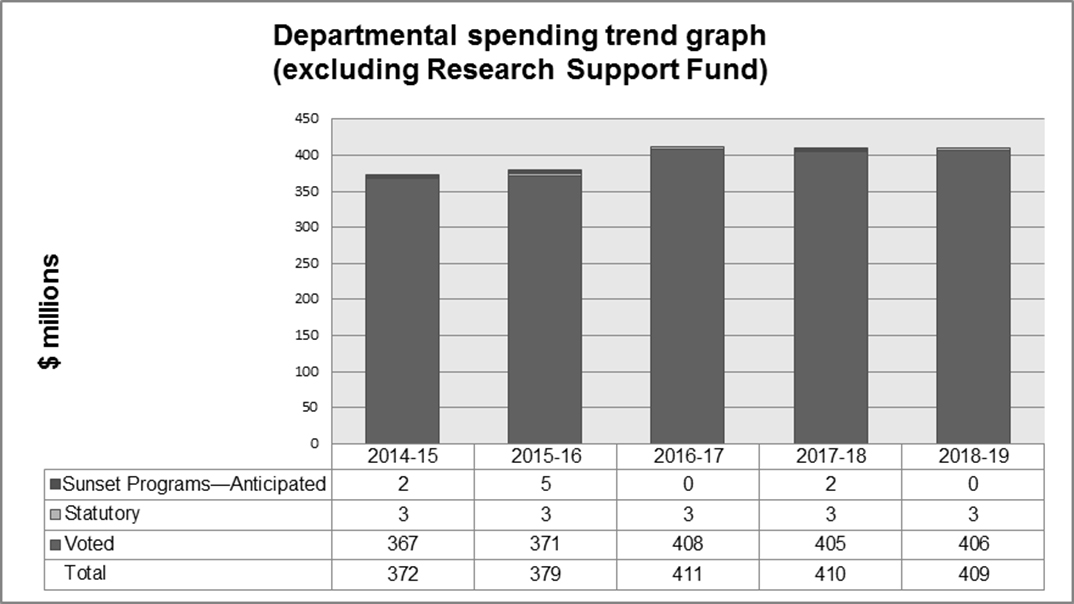
Departmental spending trend graph
Description of figure
Description of Departmental Spending Trend Graph (excluding the Research Support Fund)
This stacked bar graph shows the trend for spending by the Social Sciences and Humanities Research Council (SSHRC), not including spending on the Research Support Fund, for fiscal years 2014-15 to 2018-19. Each bar is broken down by sunset programs, statutory programs and voted programs. Spending is shown in millions of dollars.
The x-axis shows five fiscal years: 2014-15, 2015-16, 2016-17, 2017-18 and 2018-19.
The y-axis shows dollar values. The scale begins at zero and goes to 450 million dollars, in increments of 50 million.
Directly below the x-axis is the legend showing which shading represents which type of program. To the right of the legend is a table with the totals, by fiscal year, for the different SSHRC program types, as follows:
- Sunset Programs—anticipated (first row) are represented by the dark shading at the top of the bars;
- Statutory programs (second row) are represented by the pale shading below the sunset programs on the bars (where there is spending on sunset programs);
- Voted programs (third row) are represented by medium shading, below the statutory programs on the bars; and
- the fourth row presents the totals for all of the above programs for each fiscal year.
The value of SSHRC’s sunset programs is 2 million dollars for 2014-15, 5 million dollars for 2015-16, zero dollars for 2016-17, 2 million dollars for 2017-18, and zero dollars for 2018-19.
The value of SSHRC’s statutory programs for each fiscal year from 2014-15 until 2018-19 is 3 million dollars.
SSHRC’s voted spending (excluding the Research Support Fund) by fiscal year is 367 million dollars for 2014-15; 371 million dollars for 2015-16; 408 million dollars for 2016-17; 405 million dollars for 2017-18; and 406 million dollars for 2018-19.
The totals for all programs (excluding the Research Support Fund) is 372 million dollars for 2014-15, 379 million dollars for 2015-16, 411 million dollars for 2016-17, 410 million dollars for 2017-18, and 409 million dollars for 2018-19.

Description of figure
Description of Departmental Spending Trend Graph for the Research Support Fund
This bar graph shows the trend for spending by the Social Sciences and Humanities Research Council (SSHRC) on the Research Support Fund for fiscal years 2014-15 to 2018-19. Each bar is broken down by sunset programs, statutory programs and voted programs. Spending is shown in millions of dollars.
The x-axis shows five fiscal years: 2014-15, 2015-16, 2016-17, 2017-18 and 2018-19.
The y-axis shows dollar values. The scale begins at zero and goes to 400 million dollars, in increments of 50 million.
Directly below the x-axis is the legend showing which shading represents which type of program. To the right of the legend is a table with the totals, by fiscal year, for the different program types, as follows:
- Sunset Programs—anticipated (first row) are represented by dark shading; however, the Research Support Fund is not a sunset program, so the value for each fiscal year from 2014-15 until 2018-19 is zero, and no dark shading appears on the graph;
- Statutory programs (second row) are represented by pale shading; however, the Research Support Fund is not a statutory program, so the value for each fiscal year from 2014-15 until 2018-19 is zero, and no pale shading appears on the graph;
- Voted programs (third row) are represented by medium shading; since the Research Support Fund is a voted program, all bars include only medium shading; and
- the fourth row presents the totals for the Research Support Fund programs for each fiscal year, which are identical to the voted spending for each fiscal year.
SSHRC’s voted spending on the Research Support Fund, as well as SSHRC’s total spending on the Research Support Fund, by fiscal year, is 341 million dollars for 2014-15; 341 million dollars for 2015-16; 369 million dollars for 2016-17; 370 million dollars for 2017-18; and 370 million dollars for 2018-19.
In both graphs, the 2017-18 and 2018-19 columns indicate planned expenditures.
Budgetary Performance Summary for Programs and Internal Services (dollars)
| Programs and Internal Services | 2016-17 Main Estimates |
2016-17 Planned Spending |
2017–18 Planned Spending |
2018–19 Planned Spending |
2016-17 Total Authorities Available for Use | 2016-17 Actual Spending (authorities used) |
2015-16 Actual Spending (authorities used) |
2014–15 Actual Spending (authorities used) |
|---|---|---|---|---|---|---|---|---|
| 1.1 Talent: attraction, retention and development of students and researchers in the social sciences and humanities | 173,493,111 | 173,493,111 | 174,512,591 | 174,518,062 | 173,551,701 | 172,100,909 | 169,294,848 | 168,129,181 |
| 1.2 Insight: new knowledge in the social sciences and humanities | 159,789,803 | 159,789,803 | 179,931,376 | 176,694,897 | 183,349,926 | 180,034,365 | 162,450,407 | 154,341,344 |
| 1.3 Connection: mobilization of social sciences and humanities knowledge | 28,590,819 | 28,590,819 | 29,484,082 | 26,662,581 | 30,203,118 | 34,477,611 | 32,964,773 | 33,309,316 |
| 2.1 Indirect costs of research (Research Support Fund) | 341,615,386 | 341,615,386 | 369,620,441 | 369,625,331 | 368,659,104 | 368,679,893 | 340,666,298 | 340,902,057 |
| 2.2 Canada First Research Excellence Fund | 2,494,438 | 2,494,438 | 13,506,758 | 19,048,156 | 7,970,239 | 8,016,252 | 2,545,724 | 0 |
| Subtotal | 705,983,557 | 705,983,557 | 767,055,248 | 766,549,027 | 763,734,088 | 763,309,030 | 707,922,050 | 696,681,898 |
Internal Services |
14,029,252 | 14,029,252 | 12,188,608 | 12,179,092 | 15,283,708 | 12,645,018 | 12,370,089 | 16,244,750 |
| Total | 720,012,809 | 720,012,809 | 779,243,856 | 778,728,119 | 779,017,796 | 775,954,048 | 720,292,139 | 712,926,648 |
The increase in total 2016-17 expenses compared to planned expenses is due mainly to increased spending in the following program areas:
- The Insight program variance is due to a $13 million increase in Insight Grants and Insight Development Grants funding, from Budget 2016, to enable scholars to address complex issues related to individuals and societies. Budget 2015 provided a $6.5 million increase in Partnership Grants funding, to further our collective understanding and support collaborations between academic researchers, business and other partners, in order to advance research and knowledge mobilization in the social sciences and humanities.
- The Connection program increase is mainly due to the $1.3 million increase in funding for the CERC awarded in 2016-17, and a reallocation of funding from various Talent program funding opportunities and from the Insight Grants. Of these reallocations, the most significant was the $2.3 million reallocated from the Canada Research Chairs Program (within the Talent program).
The $27 million increase in funding for the Research Support Fund is due mainly to Budget 2015 and 2016 announcements. The variance comparative to planned spending for CFREF is due to $5.4 million for projects funded through the second competition, provided from Budget 2014.
Actual human resources
Human resources summary for Programs and Internal Services (full-time equivalents)
| Programs and Internal Services | 2014–15 Actual |
2015–16 Actual |
2016–17 Planned |
2016–17 Actual |
2017–18 Planned |
2017–18 Planned |
|---|---|---|---|---|---|---|
| 1.1 Talent: attraction, retention and development of students and researchers in the social sciences and humanities | 39 | 50 | 45 | 51 | 52 | 52 |
| 1.2 Insight: new knowledge in the social sciences and humanities | 46 | 60 | 53 | 63 | 64 | 64 |
| 1.3 Connection: mobilization of social sciences and humanities knowledge | 8 | 12 | 10 | 13 | 13 | 13 |
| 2.1 Indirect costs of research (Research Support Fund) | 3 | 2 | 2 | 2 | 2 | 2 |
| 2.2 Canada First Research Excellence Fund | 0 | 6 | 6 | 6 | 5 | 5 |
| Subtotal | 96 | 130 | 116 | 135 | 136 | 136 |
| Internal Services | 111 | 88 | 105 | 93 | 91 | 91 |
| Total | 207 | 218 | 221 | 228 | 227 | 227 |
The programs increase, and internal services decrease, in FTEs is due mainly to a change in the reallocation of internal services resources to programs, based on Treasury Board Secretariat’s Guide on Recording and Reporting of Internal Services Expenditures, effective February 29, 2016. The variance between planned and actual FTEs for the Insight program is partially due to an increase, from Budget 2015, for partnership activities between academic researchers, business and other partners; and from Budget 2016, for investigator-led discovery research in the social sciences and humanities.
Expenditures by vote
For information on the SSHRC’s organizational voted and statutory expenditures, consult the Public Accounts of Canada 2017 Footnote 36.
Alignment of spending with the whole-of-government framework
Alignment of 2016-17 actual spending with the whole-of-government framework Footnote 37 (dollars)
| Program | Spending area | Government of Canada activity | 2016–17 Actual spending |
|---|---|---|---|
| 1.1 Talent: attraction, retention and development of students and researchers in the social sciences and humanities | Economic affairs | An innovative and knowledge-based economy | 172,100,909 |
| 1.2 Insight: new knowledge in the social sciences and humanities | Economic affairs | An innovative and knowledge-based economy | 180,034,365 |
| 1.3 Connection: mobilization of social sciences and humanities knowledge | Economic affairs | An innovative and knowledge-based economy | 34,477,611 |
| 2.1 Indirect costs of research (Research Support Fund) | Economic affairs | An innovative and knowledge-based economy | 368,679,893 |
Total spending by spending area (dollars)
| Spending area | Total planned spending | Total actual spending |
|---|---|---|
| Economic affairs | 705,983,557 | 763,309,030 |
| Social affairs | 0 | 0 |
| International affairs | 0 | 0 |
| Government affairs | 0 | 0 |
Financial statements and financial statements highlights
Financial statements
SSHRC’s audited financial statements for the year ended March 31, 2017, are available on the departmental website Footnote 38.
Financial statements highlights
Condensed Statement of Operations (unaudited) for the year ended March 31, 2017 (dollars)
| Financial information | 2016–17 Planned results | 2016–17 Actual |
2015–16 Actual |
Difference (2016–17 actual minus 2016–17 planned) | Difference (2016–17 actual minus 2015–16 actual) |
|---|---|---|---|---|---|
| Total expenses | 724,673,696 | 778,264,541 | 723,122,056 | 53,590,845 | 55,142,485 |
| Total revenues | 94,976 | 204,628 | 67,622 | 109,652 | 137,006 |
| Net cost of operations before government funding and transfers | 724,578,720 | 778,059,913 | 723,054,434 | 53,481,193 | 55,005,479 |
SSHRC’s Unaudited Future-Oriented Statement of Operations for the year ended March 31, 2017, is available on the departmental website.
The increase in total expenses over the previous year is due mainly to increases in grant and scholarship payments in the following initiatives:
- an increase of $27 million in the Research Support Fund;
- a $13 million increase in Insight Grants funding;
- a $6.5 million increase in Partnership Grants funding;
- an increase of $5.4 million for CFREF, due to the second round of competition, held in 2016-17; and
- an increase of $1.3 million for CERC.
Condensed Statement of Financial Position (unaudited) as at March 31, 2017 (dollars)
| Financial Information | 2016–17 | 2015–16 | Difference (2016–17 minus 2015–16) |
|---|---|---|---|
| Total net liabilities | 5,088,826 | 4,999,847 | 88,979 |
| Total net financial assets | 4,255,268 | 3,971,751 | 283,517 |
| Departmental net debt | 833,558 | 1,028,095 | (194,537) |
| Total non-financial assets | 2,997,432 | 3,821,993 | (824,561) |
| Departmental net financial position | 2,163,874 | 2,793,897 | (630,023) |
The decrease in non-financial assets is due mainly to the annual depreciation of SSHRC’s tangible capital assets, which surpassed the value of new assets added during the year.
Supplementary information
Corporate information
Organizational profile
Appropriate ministers:
The Honourable Kirsty Duncan, P.C., M.P.
Minister of Science
Institutional head:
Ted Hewitt, President
Ministerial portfolio:
Innovation, Science and Economic Development
Enabling instruments:
Social Sciences and Humanities Research Council Act, R.S.C. 1985, c. S-12 Footnote 39
Year of incorporation / commencement:
1977
Reporting framework
SSHRC’s Strategic Outcomes and Program Alignment Architecture of record for 2016-17 are shown below:
- 1. Strategic Outcome: Canada is a world leader in social sciences and humanities research and research training.
- 1.1 Program: Talent: attraction, retention and development of students and researchers in the social sciences and humanities
- 1.1.1 Sub-Program: Canada Research Chairs
- 1.1.2 Sub-Program: Canada Graduate Scholarships
- 1.1.3 Sub-Program: Vanier Canada Graduate Scholarships
- 1.1.4 Sub-Program: Banting Postdoctoral Fellowships
- 1.1.5 Sub-Program: Doctoral and Postdoctoral Fellowships
- 1.2 Program: Insight: new knowledge in the social sciences and humanities
- 1.2.1 Sub-Program: Individual, team and partnership research grants
- 1.2.2 Sub-Program: Institutional research capacity grants
- 1.3 Program: Connection: mobilization of social sciences and humanities knowledge
- 1.3.1 Sub-Program: Individual, team and partnership knowledge mobilization grants
- 1.3.2 Sub-Program: Research-based knowledge culture
- 1.3.3 Sub-Program: Networks of Centres of Excellence
- 1.1 Program: Talent: attraction, retention and development of students and researchers in the social sciences and humanities
- 2. Strategic Outcome: Canada has the institutional capacity to enable research and research-related activities in social sciences and humanities, natural sciences and engineering and health.
- 2.1 Program: Indirect costs of research
- 2.2 Program: Canada First Research Excellence Fund
- Internal Services
Supporting information on lower-level programs
Supporting information on lower-level programs is available on the SSHRC’s website.
Supplementary information tables
The following supplementary information tables are available on the SSHRC’s website Footnote 40.
- Departmental Sustainable Development Strategy
- Details on Transfer Payment Programs of $5 Million or More
- Internal Audits and Evaluations
Federal tax expenditures
The tax system can be used to achieve public policy objectives through the application of special measures such as low tax rates, exemptions, deductions, deferrals and credits. The Department of Finance Canada publishes cost estimates and projections for these measures each year in the Report on Federal Tax Expenditures Footnote 41. This report also provides detailed background information on tax expenditures, including descriptions, objectives, historical information and references to related federal spending programs. The tax measures presented in this report are the responsibility of the Minister of Finance.
Organizational contact information
Matthew Lucas
Executive Director
Corporate Strategy and Performance
Social Sciences and Humanities Research Council
350 Albert Street
Ottawa, ON K1P 6G4
Canada
Telephone: 613-944-6230
Email: matthew.lucas@sshrc-crsh.gc.ca
Appendix: Definitions
appropriation (crédit)
Any authority of Parliament to pay money out of the Consolidated Revenue Fund.
budgetary expenditures (dépenses budgétaires)
Operating and capital expenditures; transfer payments to other levels of government, organizations or individuals; and payments to Crown corporations.
Core Responsibility (responsabilité essentielle)
An enduring function or role performed by a department. The intentions of the department with respect to a Core Responsibility are reflected in one or more related Departmental Results that the department seeks to contribute to or influence.
Departmental Plan (Plan ministériel)
Provides information on the plans and expected performance of appropriated departments over a three-year period. Departmental Plans are tabled in Parliament each spring.
Departmental Result (résultat ministériel)
A Departmental Result represents the change or changes that the department seeks to influence. A Departmental Result is often outside departments’ immediate control, but it should be influenced by program-level outcomes.
Departmental Result Indicator (indicateur de résultat ministériel)
A factor or variable that provides a valid and reliable means to measure or describe progress on a Departmental Result.
Departmental Results Framework (cadre ministériel des résultats)
Consists of the department’s Core Responsibilities, Departmental Results and Departmental Result Indicators.
Departmental Results Report (Rapport sur les résultats ministériels)
Provides information on the actual accomplishments against the plans, priorities and expected results set out in the corresponding Departmental Plan.
Evaluation (évaluation)
In the Government of Canada, the systematic and neutral collection and analysis of evidence to judge merit, worth or value. Evaluation informs decision-making, improvements, innovation and accountability. Evaluations typically focus on programs, policies and priorities, and examine questions related to relevance, effectiveness and efficiency. Depending on user needs, however, evaluations can also examine other units, themes and issues, including alternatives to existing interventions. Evaluations generally employ social science research methods.
full-time equivalent (équivalent temps plein)
A measure of the extent to which an employee represents a full person-year charge against a departmental budget. Full-time equivalents are calculated as a ratio of assigned hours of work to scheduled hours of work. Scheduled hours of work are set out in collective agreements.
government-wide priorities (priorités pangouvernementales)
For the purpose of the 2016-17 Departmental Results Report, government-wide priorities refers to those high-level themes outlining the government’s agenda in the 2015 Speech from the Throne, namely: Growth for the Middle Class; Open and Transparent Government; A Clean Environment and a Strong Economy; Diversity is Canada's Strength; and Security and Opportunity.
horizontal initiatives (initiative horizontale)
An initiative where two or more federal organizations, through an approved funding agreement, work toward achieving clearly defined shared outcomes, and which has been designated (for example, by Cabinet or a central agency) as a horizontal initiative for managing and reporting purposes.
Management, Resources and Results Structure (Structure de la gestion, des ressources et des résultats)
A comprehensive framework that consists of an organization’s inventory of programs, resources, results, performance indicators and governance information. Programs and results are depicted in their hierarchical relationship to each other and to the Strategic Outcome(s) to which they contribute. The Management, Resources and Results Structure is developed from the Program Alignment Architecture.
non-budgetary expenditures (dépenses non budgétaires)
Net outlays and receipts related to loans, investments and advances, which change the composition of the financial assets of the Government of Canada.
performance (rendement)
What an organization did with its resources to achieve its results, how well those results compare to what the organization intended to achieve, and how well lessons learned have been identified.
performance indicator (indicateur de rendement)
A qualitative or quantitative means of measuring an output or outcome, with the intention of gauging the performance of an organization, program, policy or initiative respecting expected results.
performance reporting (production de rapports sur le rendement)
The process of communicating evidence-based performance information. Performance reporting supports decision-making, accountability and transparency.
planned spending (dépenses prévues)
For Departmental Plans and Departmental Results Reports, planned spending refers to those amounts that receive Treasury Board approval by February 1. Therefore, planned spending may include amounts incremental to planned expenditures presented in the Main Estimates.
A department is expected to be aware of the authorities that it has sought and received. The determination of planned spending is a departmental responsibility, and departments must be able to defend the expenditure and accrual numbers presented in their Departmental Plans and Departmental Results Reports.
plans (plans)
The articulation of strategic choices, which provides information on how an organization intends to achieve its priorities and associated results. Generally, a plan will explain the logic behind the strategies chosen and tend to focus on actions that lead up to the expected result.
priorities (priorité)
Plans or projects that an organization has chosen to focus and report on during the planning period. Priorities represent the things that are most important or what must be done first to support the achievement of the desired Strategic Outcome(s).
program (programme)
A group of related resource inputs and activities that are managed to meet specific needs and to achieve intended results and that are treated as a budgetary unit.
Program Alignment Architecture (architecture d’alignement des programmes)
A structured inventory of an organization’s programs depicting the hierarchical relationship between programs and the Strategic Outcome(s) to which they contribute.
results (résultat)
An external consequence attributed, in part, to an organization, policy, program or initiative. Results are not within the control of a single organization, policy, program or initiative; instead, they are within the area of the organization’s influence.
statutory expenditures (dépenses législatives)
Expenditures that Parliament has approved through legislation other than appropriation acts. The legislation sets out the purpose of the expenditures and the terms and conditions under which they may be made.
Strategic Outcome (résultat stratégique)
A long-term and enduring benefit to Canadians that is linked to the organization’s mandate, vision and core functions.
sunset program (programme temporisé)
A time-limited program that does not have an ongoing funding and policy authority. When the program is set to expire, a decision must be made whether to continue the program. In the case of a renewal, the decision specifies the scope, funding level and duration.
target (cible)
A measurable performance or success level that an organization, program or initiative plans to achieve within a specified time period. Targets can be either quantitative or qualitative.
voted expenditures (dépenses votées)
Expenditures that Parliament approves annually through an Appropriation Act. The Vote wording becomes the governing conditions under which these expenditures may be made.
Endnotes
- Footnote 1
-
Advancing Knowledge for Canada’s Future, www.sshrc-crsh.gc.ca/about-au_sujet/publications/strategic-plan-strategique-2016-eng.pdf
- Footnote 2
-
Canada’s Fundamental Science Review, www.sciencereview.ca/eic/site/059.nsf/eng/home
- Footnote 3
-
Tri-agency Statement of Principles on Digital Data Management, www.science.gc.ca/eic/site/063.nsf/eng/h_83F7624E.html?OpenDocument
- Footnote 4
-
Tri-Agency Open Access Policy on Publications, www.science.gc.ca/eic/site/063.nsf/eng/h_F6765465.html?OpenDocument
- Footnote 5
-
Fact Sheet: Aboriginal Research, www.sshrc-crsh.gc.ca/news_room-salle_de_presse/fact_sheets-fiches_information/PDF/Aboriginal_fact_sheet_e.pdf
- Footnote 6
-
Truth and Reconciliation Commission of Canada: Calls to Action, www.trc.ca/websites/trcinstitution/File/2015/Findings/Calls_to_Action_English2.pdf
- Footnote 7
-
SSHRC Introduces New Partnership Engage Grants, www.sshrc-crsh.gc.ca/news_room-salle_de_presse/latest_news-nouvelles_recentes/2017/partnership_engage_grants-subventions_d_engagement_partenarial-eng.aspx
- Footnote 8
-
CIGI Post-Doctoral Fellowship, www.cigionline.org/cigi-post-doctoral-fellowship
- Footnote 9
-
Queen Elizabeth II Diamond Jubilee Scholarships program, www.queenelizabethscholars.ca
- Footnote 10
-
Imagining Canada’s Future, www.sshrc-crsh.gc.ca/society-societe/community-communite/Imagining_Canadas_Future-Imaginer_l_avenir_du_Canada-eng.aspx
- Footnote 11
-
Ministers’ mandate letters, pm.gc.ca/eng/mandate-letters
- Footnote 12
-
Canada’s Fundamental Science Review, www.sciencereview.ca/eic/site/059.nsf/eng/home
- Footnote 13
-
Report on Plans and Priorities 2016-17, www.sshrc-crsh.gc.ca/about-au_sujet/publications/rpp/2016-2017/rpp-eng.aspx
- Footnote 14
-
Truth and Reconciliation Commission of Canada: Calls to Action, www.trc.ca/websites/trcinstitution/File/2015/Findings/Calls_to_Action_English2.pdf
- Footnote 15
-
Tri-Agency Research Training Award Holder’s Guide, www.nserc-crsng.gc.ca/Students-Etudiants/Guides-Guides/TriRTA-TriBFR_eng.asp
- Footnote 16
-
CIGI Post-Doctoral Fellowship, www.cigionline.org/cigi-post-doctoral-fellowship
- Footnote 17
-
Queen Elizabeth II Diamond Jubilee Scholarships, www.queenelizabethscholars.ca/
- Footnote 18
-
Canada Excellence Research Chair in Data-Intensive Methods in Economics, www.cerc.gc.ca/chairholders-titulaires/snowberg-eng.aspx
- Footnote 19
-
Equity, Diversity and Inclusion Action Plan, www.chairs-chaires.gc.ca/program-programme/equity-equite/action_plan-plan_action-eng.aspx
- Footnote 20
-
Evaluation of the Canada Research Chairs Program, www.chairs-chaires.gc.ca/about_us-a_notre_sujet/publications/evaluations/chairs_evaluation-chaires_evaluation-eng.aspx
- Footnote 21
-
SSHRC Introduces New Partnership Engage Grants, www.sshrc-crsh.gc.ca/news_room-salle_de_presse/latest_news-nouvelles_recentes/2017/partnership_engage_grants-subventions_d_engagement_partenarial-eng.aspx
- Footnote 22
-
Tri-agency Statement of Principles on Digital Data Management, www.science.gc.ca/eic/site/063.nsf/eng/h_83F7624E.html?OpenDocument
- Footnote 23
-
Trans-Atlantic Platform, www.transatlanticplatform.com/
- Footnote 24
-
Digging into Data Challenge, diggingintodata.org/
- Footnote 25
-
Evaluation of the SSHRC Insight Grants and Insight Development Grants, www.sshrc-crsh.gc.ca/about-au_sujet/publications/evaluations-eng.aspx
- Footnote 26
-
Evaluation of the SSHRC Institutional Grants (SIG) and Aid to Small Universities (ASU) Programs, www.sshrc-crsh.gc.ca/about-au_sujet/publications/evaluations-eng.aspx
- Footnote 27
-
Imagining Canada’s Future, www.sshrc-crsh.gc.ca/society-societe/community-communite/Imagining_Canadas_Future-Imaginer_l_avenir_du_Canada-eng.aspx
- Footnote 28
-
The Walrus Talks National Tour, thewalrus.ca/canada150/
- Footnote 29
-
Tenth-year Evaluation of the Indirect Costs Program, www.rsf-fsr.gc.ca/about-au_sujet/publications/2014_Evaluation_Report_Eng.pdf
- Footnote 30
-
Tenth-year Evaluation of the Indirect Costs Program, www.rsf-fsr.gc.ca/about-au_sujet/publications/2014_Evaluation_Report_Eng.pdf
- Footnote 31
-
Evaluation of the Canada Research Chairs Program, www.chairs-chaires.gc.ca/about_us-a_notre_sujet/publications/evaluations/chairs_evaluation-chaires_evaluation-eng.aspx
- Footnote 32
-
Equity, Diversity and Inclusion Action Plan, www.chairs-chaires.gc.ca/program-programme/equity-equite/action_plan-plan_action-eng.aspx
- Footnote 33
-
Open Government Implementation Plan, www.tsb.gc.ca/eng/publications/pmogo-ogip/2015/pmogo-ogip.asp
- Footnote 34
-
Corporate Reports, www.sshrc-crsh.gc.ca/about-au_sujet/publications/corporate_reports-rapports_organisationnels-eng.aspx
- Footnote 35
-
TBS InfoBase, www.tbs-sct.gc.ca/ems-sgd/edb-bdd/index-eng.html#start
- Footnote 36
-
Public Accounts of Canada 2017, www.tpsgc-pwgsc.gc.ca/recgen/cpc-pac/index-eng.html
- Footnote 37
-
Whole-of-government framework, www.tbs-sct.gc.ca/ppg-cpr/frame-cadre-eng.aspx
- Footnote 38
-
Corporate Reports, www.sshrc-crsh.gc.ca/about-au_sujet/publications/corporate_reports-rapports_organisationnels-eng.aspx
- Footnote 39
-
Social Sciences and Humanities Research Council Act, laws.justice.gc.ca/eng/acts/S-12
- Footnote 40
-
Corporate Reports, www.sshrc-crsh.gc.ca/about-au_sujet/publications/corporate_reports-rapports_organisationnels-eng.aspx#a1
- Footnote 41
-
Report on Federal Tax Expenditures, www.fin.gc.ca/purl/taxexp-eng.asp
Page details
From:
- Date modified: