
Social Sciences and Humanities Research Council’s 2025-26 Departmental plan
On this page:
- From the Minister
- From the President
- Plans to deliver on core responsibilities and internal services
- Planned spending and human resources
- Corporate information
- Supplementary information tables
- Federal tax expenditures
- Definitions
Copyright information
© His Majesty the King in Right of Canada, as represented by the Minister of Innovation, Science and Industry, 2025, ISSN: 2371-8080
From the Minister

The Honourable Mélanie Joly
Minister of Industry and Minister responsible for Canada Economic Development for Quebec Regions
It is our pleasure to present the 2025-26 Departmental Plan for the Social Sciences and Humanities Research Council (SSHRC), which lays out the key priorities the agency is working to advance for the benefit of all Canadians.
In 2025-26, ISED will continue working with the ISED Portfolio and other federal partners to bolster Canadian innovation by fostering competitive, sustainable and inclusive economic growth.
Through its suite of programs, SSHRC will continue to support world-leading, innovative research in the social sciences and humanities and research training to advance knowledge, develop talent and build connections that strengthen the Canadian research enterprise, enhance its international competitiveness, and contribute to Canada’s ever-growing knowledge-based society and economy.
SSHRC remains committed to advancing the priorities of the Canada Research Coordinating Committee. The agency will continue to foster an equitable, inclusive and diverse research ecosystem where different expertise, ideas and perspectives are recognized as strengths. It will also further Indigenous research priorities and work with Indigenous researchers and communities to co-develop an interdisciplinary research and research training model that contributes to reconciliation. SSHRC is also focused on developing a strong system of training support to prepare the full breadth of the next generation of highly skilled knowledge workers.
Central to SSHRC’s work is its commitment to preserving the integrity of Canada’s research ecosystem, while promoting an open, collaborative research environment through sound practices. In partnership with the other federal research funding agencies—the Natural Sciences and Engineering Research Council and the Canadian Institutes of Health Research—SSHRC will continue to implement federal and tri-agency policies and guidelines aimed at ensuring Canadian-led research is safeguarded against threats to national and economic security and maximizes its benefits for Canadians. SSHRC will also work with the research community to further responsible data stewardship, oversight and management, and the open sharing and exchange of research knowledge.
We invite you to read this report to learn more about how ISED, along with its Portfolio partners, is supporting all Canadians to participate in and benefit from a competitive and growing economy.
From the President

Ted Hewitt, PhD
President, Social Sciences and Humanities Research Council
I am pleased to present SSHRC’s 2025-26 Departmental Plan, which outlines our priorities, strategies and commitments for the year ahead. As Canada’s federal funder of social sciences and humanities research, SSHRC has an unwavering commitment to advancing knowledge in these fields. The programs we provide enable the nation’s research community to address the complex social, environmental, economic and health challenges facing Canada and the world. We also deliver prestigious, multidisciplinary programs on behalf of the three federal research funding agencies, bringing together the best researchers working across all fields, for maximum potential benefit to society. Through strategic investments in national and international partnerships and program development, collaborations with other funding agencies, and modernizing its operations, SSHRC is strengthening Canada’s research enterprise and supporting impactful solutions for a more sustainable, inclusive future.
SSHRC builds partnerships at both national and international levels to collaboratively advance and mobilize research knowledge, while enabling Canadian researchers themselves to team up with leading international peers to drive innovation. SSHRC’s joint initiatives play a key role in enhancing the international competitiveness of Canada’s social sciences and humanities research and talent development. SSHRC’s new Destination Horizon Grants is the product of the strong research partnership between Canada and the European Union. Through Canada’s participation in the Horizon Europe program, the grants will help Canadian researchers build capacity and further develop international networks and collaborations.
Driven by the rapid development of and growing global investment in artificial intelligence (AI), and the profound impact this technology is having on our economies, societies and well-being, SSHRC, alongside the other federal research funding agencies, the Natural Sciences and Engineering Research Council (NSERC) and Canadian Institutes of Health Research (CIHR), is partnering with the French National Research Agency and the Canadian research and knowledge mobilization consortium IVADO, to support collaborative multi- and interdisciplinary research projects on AI. Through the NordForsk-led International Joint Initiative on Sustainable Development of the Arctic, SSHRC is also working with research funders from Canada, the United States and other Arctic countries to support research exploring approaches to sustainable development in the region. In addition, collaborations through SSHRC’s Knowledge Synthesis Grants delivered in partnership with other organizations will mobilize, examine and synthesize social sciences and humanities research so that research knowledge is effectively shared and applied, maximizing its potential impacts.
Together, SSHRC, NSERC and CIHR are also modernizing Canada’s federal research support system to respond to the rapidly evolving research landscape and provide the research community with harmonized, streamlined, user-friendly programs. This will also reduce the administrative burden on applicants, reviewers and institutional partners, and address barriers to full, equitable participation. As part of these efforts, the agencies are launching a new, harmonized suite of scholarships and fellowships, strengthening support for research training to meet the changing needs of students and postdoctoral fellows. SSHRC, NSERC and CIHR are also implementing the tri-agency grants management solution. The system, released over multiple years, will deliver improved, harmonized grant management with advanced digital and client-centred features.
SSHRC’s continued collaboration with its fellow research federal funding agencies and other departments brings strategic vision and coordination to the federal research support system, while preserving the features underlying Canada’s strong record of research excellence. The agencies are continuing to drive collaboration and support research initiatives to address defined goals and societal challenges of strategic importance to Canada.
SSHRC’s support of excellence in investigator-driven research and training, and the Canadian research that results, is better positioning the country to meet and address emerging challenges. The work and initiatives reflected in this Departmental Plan aim to equip Canada’s researchers with the resources and opportunities to generate social, political and economic insights that will foster innovation and benefit the lives of all Canadians.
Plans to deliver on core responsibilities and internal services
Core responsibilities and internal services
- Core responsibility 1: Funding Social Sciences and Humanities Research and Training
- Core responsibility 2: Institutional Support for the Indirect Costs of Research
- Internal services
Core responsibility 1: Funding Social Sciences and Humanities Research and Training
In this section
Description
The Social Sciences and Humanities Research Council (SSHRC), through grants, fellowships and scholarships, promotes and supports research and research training in the social sciences and humanities to develop talent, generate insights, and build connections in pursuit of social, cultural and economic outcomes for Canadians.
Quality of life impacts
Considering the topics and application of the findings from funded research, SSHRC’s programs and activities have direct and indirect impacts on most Quality of Life indicators. This core responsibility contributes particularly to the “Prosperity” domain of the Quality of Life Framework for Canada, more specifically to “Investment in in-house research and development” and “Postsecondary attainment” through all the activities mentioned in the core responsibility description.
Indicators, results and targets
This section presents details on the department’s indicators, the actual results from the three most recently reported fiscal years, the targets and target dates approved in 2025-26 for Funding Social Sciences and Humanities Research training. Details are presented by departmental result.
Table 1: Canada’s social sciences and humanities research is internationally competitive.
Tables 1-3 provide a summary of the target and actual results for each indicator associated with the results under Funding Social Sciences and Humanities Research and Training.
| Departmental Result Indicators | Actual Results | Target | Date to achieve target |
|---|---|---|---|
| Canada’s rank among Organisation for Economic Co-operation and Development nations on the citation score of social sciences and humanities research publications | 2021-22: 20 2022-23: 23 2023-24: 27 |
In the top 10 | March 2026 |
| Percentage of funded projects involving international collaborations | 2021-22: 55% 2022-23: 57% 2023-24: 57% |
At least 55% | March 2026 |
| Number of research projects funded jointly by SSHRC and international partner(s) | 2021-22: 11 2022-23: 6 2023-24: 7 |
At least 9 | March 2026 |
Table 2: Canada has a pool of diverse and highly skilled people in the social sciences and humanities.
| Departmental Result Indicators | Actual Results | Target | Date to achieve target |
|---|---|---|---|
| Percentage of newly funded recipients who self-identify as women | 2021-22: 58.5% 2022-23: 58.6% 2023-24: 57.9% |
At least 51% | March 2026 |
| Percentage of newly funded recipients who self-identify as visible minorities | 2021-22: 20.6% 2022-23: 21.8% 2023-24: 22.2% |
At least 23% | March 2026 |
| Percentage of newly funded recipients who self-identify as Indigenous Peoples | 2021-22: 3.5% 2022-23: 3.0% 2023-24: 2.8% |
At least 5% | March 2026 |
| Percentage of newly funded recipients who self-identify as persons with disabilities | 2021-22: 5.6% 2022-23: 9.0% 2023-24: 10.5% |
At least 9% | March 2026 |
| Number of research trainees supported through grants | 2021-22: 4,390 2022-23: 5,240 2023-24: 7,774 |
At least 6,000 | March 2026 |
| Number of research trainees supported by SSHRC through scholarships and fellowships | 2021-22: 4,945 2022-23: 4,882 2023-24: 4,880 |
At least 4,500 | March 2026 |
| Percentage of funded research trainees who go on to work in a research position | 2021-22: 59% 2022-23: 62% 2023-24: 62% |
At least 55% | March 2026 |
Table 3: Canada’s social sciences and humanities research knowledge is used.
| Departmental Result Indicators | Actual Results | Target | Date to achieve target |
| Funding from non-academic partners for research projects | 2021-22: $35,155,008 2022-23: $37,724,322 2023-24: $38,384,217 |
At least $35,000,000 | March 2026 |
| Number of non-academic partners in research projects | 2021-22: 929 2022-23: 771 2023-24: 683 |
At least 850 | March 2026 |
| Percentage of grants reporting non-academic collaborator(s) in the research process | 2021-22: 76% 2022-23: 75% 2023-24: 73% |
At least 70% | March 2026 |
| Percentage of funded projects reporting socioeconomic outcomes for Canadians | 2021-22: 76% 2022-23: 79% 2023-24: 79% |
At least 75% | March 2026 |
Additional information on the detailed results and performance information for SSHRC’s program inventory is available on GC InfoBase.
Plans to achieve results
SSHRC promotes research and research training in the social sciences and humanities and supports a large research community, including more than 23,900 full-time university professors, college and CEGEP professors, and close to 48,000 full-time graduate students and postdoctoral researchers. Through its regular grants, scholarships and fellowships funding programs, SSHRC will continue in 2025-26 to support training, investigator-led research, and research partnerships in the social sciences and humanities, as well as in interdisciplinary research, while also continuing to collaborate across the research ecosystem to foster initiatives that contribute to ensuring a better future for Canadians.
SSHRC, through its Tri-agency Institutional Programs Secretariat, also administers several research funding programs on behalf of Canada’s three federal research funding agencies: the Canadian Institutes of Health Research (CIHR), the Natural Sciences and Engineering Research Council (NSERC) and SSHRC. These tri-agency programs enhance Canada’s research capacity by supporting top-tier researchers to advance ambitious research agendas, by enabling interdisciplinary, collaborative and mission-oriented research that addresses global challenges, and by helping to maintain a strong research environment in Canada’s institutions.
The following section describes the planned results for Funding Social Sciences and Humanities Research and Training in 2025-26.
Departmental Result 1: Canada’s social sciences and humanities research is internationally competitive.
At its foundation, SSHRC supports world-class research by awarding highly competitive funding to scholars and students through rigorous, independent merit review aligned with international best practices. SSHRC’s funding programs, policies and initiatives help ensure that Canada’s social sciences and humanities research is internationally competitive—its level of excellence and relevance attracts recognition beyond Canada’s borders, attracts top talent from around the world and attracts funding from international organizations that sign on as partners. Supporting such research excellence ultimately helps Canadian researchers and institutions lead on a global stage and drive innovations that address the most pressing societal challenges. SSHRC remains committed to improving research and funding systems, through, for instance, its engagement with the Research on Research Institute (RoRI). SSHRC is one of 18 partners from 12 countries on the RoRI program, whose mission is to improve how research is funded, practiced, communicated and evaluated.
International collaborations are one of the mechanisms through which Canada’s social sciences and humanities research becomes internationally competitive. SSHRC’s regular funding programs provide important opportunities for Canadian researchers to work and collaborate with international scholars. On average, 56% of SSHRC-funded projects involve collaborations with international researchers. Such collaborations enable researchers to learn from their colleagues around the world, share a diversity of perspectives, and foster the development of critical new knowledge at the forefront of the field, while enhancing Canada’s reputation as a global centre for research excellence. SSHRC also pursues targeted joint initiatives with international funding partners, in areas of strategic importance to Canada, providing additional opportunities for researchers to collaborate internationally on specific research topics or themes. SSHRC’s International Framework, developed in 2022, helps guide its investments and advance international engagements across SSHRC and the three federal research funding agencies.
Several tri-agency programs administered by SSHRC contribute to strengthening Canada’s ability to be internationally competitive in research areas that create long-term social and economic advantages for Canada. One example is the New Frontiers in Research Fund (NFRF), which supports world-leading interdisciplinary, international and emerging research that is high reward, high risk and transformative. NFRF projects address major societal challenges and have the potential to lead to lasting impacts in science, technology and society. Another example is the Canada Research Chairs Program that invests approximately $311 million per year to support 2,285 research chairs across the country to attract and retain world-class researchers. Through achieving research excellence in engineering and the natural sciences, health sciences, humanities and social sciences, chairholders improve our depth of knowledge and quality of life and directly strengthen Canada’s position on the world stage.
In 2025-26, SSHRC will undertake several initiatives in support of its first departmental result.
Promoting international collaborations and addressing global challenges
- Through Destination Horizon Grants, SSHRC will help Canadian researchers build capacity, strengthen existing partnerships, and further develop international networks and collaborations, with the ultimate goal of applying to Horizon Europe. Horizon Europe is a major international funding program through which Canada’s research and innovation communities can help develop solutions to some of the world’s most demanding challenges. Two competitions in 2025-26 will award one-year grants valued at up to $15,000 each.
- SSHRC, NSERC and CIHR, in collaboration with the research and knowledge mobilization consortium IVADO, are partnering with the French National Research Agency to support collaborative multi- and interdisciplinary research projects on artificial intelligence. A portion of available funding will be reserved for proposals addressing preparedness for and/or response to pandemics and infectious health emergencies, and for proposals related to cancer.
- SSHRC is continuing its participation in the Trans-Atlantic Platform—a collaboration between humanities and social science research funders from South America, North America, Europe and Africa, that supports work addressing major societal challenges—and with the US National Science Foundation’s Global Centers. SSHRC is also pursuing new collaborations with international funding partners in areas such as research training and on the changing nature of security and conflict.
Supporting tri-agency programs with international impact
- NFRF’s call related to an international joint initiative on sustainable development of the Arctic, launched in 2023-24, will see projects start in 2025-26. The 2024 NordForsk-led initiative is a collaboration among research funders from Canada, the United States and other Arctic countries. Through interdisciplinary research projects that include Indigenous perspectives, this call leverages expertise across Arctic countries to explore approaches to sustainable development, considering aspects such as security, natural resources and societal changes.
Improving research and funding practices in alignment with the international community
- Stemming from its engagement with RoRI, SSHRC will help advance Canada’s capacity for research on research, also known as metaresearch, through a joint initiative with CIHR and Michael Smith Health Research BC. The results of the competition will be announced in 2025-26 with approximately nine grants awarded, each valued at up to $200,000 over three years.
- SSHRC will continue the process of gradually transitioning funding opportunities to the new narrative-style tri-agency CV. Aligning with trends seen internationally, the new CV enables applicants to provide written descriptions of their research contributions, allowing them to highlight a wide range of research outputs and to describe their career trajectories in more detail. This format values societal research outcomes, such as influence on policy or mentorship, alongside more traditional research outputs like academic publications. The first funding opportunity to use the new tri-agency CV will be the 2025 Impact Awards competition.
Departmental result 2: Canada has a pool of diverse and highly skilled people in the social sciences and humanities.
Canada’s ability to produce excellence and impactful research depends on its capacity to develop, attract and retain highly skilled researchers. Through its scholarships, fellowships and grants, SSHRC supports the next generation of researchers and knowledge workers, promoting the development of knowledge, competencies and skills that can help address the challenges of today and tomorrow. Guided by the Tri-agency Research Training Strategy, SSHRC works to strengthen Canada’s research enterprise by creating an innovative, equitable, accessible and effective suite of programs for a diverse base of trainees, with equally diverse career pathways.
SSHRC recognizes that research excellence includes strengthening Indigenous self-determination, leadership and capacity in research and research training, and respecting Indigenous Knowledge systems. The agency is therefore committed to supporting research by and with First Nations, Inuit and Métis to advance reconciliation efforts under the guidance of its Indigenous Advisory Circle. Additionally, SSHRC promotes Indigenous research and training through activities delivered in collaboration with the other federal research funding agencies—CIHR and NSERC—and the Canada Research Coordinating Committee (CRCC). Guided by the tri-agency Indigenous Leadership Circle in Research, SSHRC is implementing the tri-agency strategic plan Setting new directions to support Indigenous research and research training in Canada. The plan lays out four directions to further advance Indigenous research and strengthen ongoing collaboration by building relationships with First Nations, Inuit and Métis Peoples, supporting Indigenous research priorities, enhancing access to agency programs and funding, and championing Indigenous leadership, self-determination and research capacity.
Did you know?
SSHRC is committed to advancing Indigenous talent development and increasing access to the research ecosystem for Indigenous scholars from the early stages of their career. The Indigenous Scholars Awards and Supplements Pilot Initiative is one of the mechanisms developed by the agency to remove some of the barriers Indigenous students experience in pursuing successful education pathways. Through this initiative, every year SSHRC offers awards and/or supplemental financial support to Indigenous students who have successfully applied to the Canada Graduate Scholars—Master’s program. This targeted financial support is intended to enable Indigenous students to concentrate more fully on their studies and research training and achieve research excellence.
A more equitable, diverse and inclusive research enterprise is essential to fostering research excellence. Under the leadership of the CRCC, SSHRC, CIHR and NSERC have therefore developed the Tri-Agency Equity, Diversity and Inclusion (EDI) Action Plan 2018-2025. The plan outlines measures aimed at enhancing equitable access to granting agency funding opportunities, fostering an inclusive postsecondary research culture in Canada and driving a system-wide transformation. SSHRC is also committed to ensuring equitable access to opportunities for Black scholars. It does so through its own suite of initiatives and in collaboration with CIHR and NSERC. Recognizing its responsibility to ensure that Black researchers have fair access to the research support it administers, SSHRC has developed its Action Plan for Black Researchers (2024-2029), informed by the recommendations of the Advisory Committee to Address Anti-Black Racism in Research and Research Training. At the same time, through the Black Scholars Initiative introduced in Budget 2022, SSHRC and the other federal research funding agencies offer dedicated funds—through existing and new tri-agency scholarship and fellowship programs—to create opportunities for an increased number of Black research trainees, including undergraduate students, benefitting Canada as a whole.
Finally, in accordance with the Accessible Canada Act, SSHRC has developed and is implementing its Accessibility Plan with the aim to identify and remove barriers that hinder the participation of persons with disabilities in the research ecosystem.
In 2025-26, SSHRC will undertake several initiatives in support of its second departmental result.
Building a robust system to enhance research training
- To offer a strong system of support, address the growing complexity of the Canadian and international research ecosystem and meet the changing needs of students and postdoctoral researchers, SSHRC will launch, in collaboration with the other federal research funding agencies, a new tri-agency harmonized program. In alignment with the Tri-agency Research Training Strategy, the new program will enhance student mobility and award international portability. It will also provide greater financial stability, enabling awardees to concentrate more fully on their research and training, thus maximizing the agencies’ impact on building research capacity.
Delivering on commitments for Indigenous Peoples
- SSHRC, along with CIHR and NSERC, will develop and launch mechanisms to deliver the new funding of $30 million announced in the 2024 federal budget to strengthen the capacity of First Nations, Inuit and Métis communities to lead their own research and partner with the broader research community.
- SSHRC will continue to implement the new Tri-Agency Policy on Indigenous Citizenship and Membership Affirmation across the agencies’ programs, including the Canada Research Chairs Program starting in June 2025, so that federal funding intended for Indigenous people is held by Indigenous people.
Fostering a research ecosystem that promotes equitable opportunities for all researchers
- SSHRC will introduce a revised Accessibility Plan to further advance accessibility and reduce barriers experienced by researchers. At the same time, it will continue to work with CIHR and NSERC on the implementation of the Tri-agency EDI action Plan.
- SSHRC will continue to implement its Action Plan for Black Researchers and will undertake a review of research policies, programs, processes and practices with a view to removing barriers for Black scholars while exploring means to support research in areas that have been historically under-funded due to systemic anti-Black racism. This comprehensive review will have a broad scope, aiming to also address challenges faced by other underrepresented groups, reinforcing the agency’s commitment to EDI and accessibility.
Departmental result 3: Canada’s social sciences and humanities research knowledge is used.
SSHRC advances world-class research in the social sciences and humanities that can help address current and future challenges. Recognizing that the application of all types of science is crucial for building resilient communities, boosting the economy, enriching our cultural landscape and improving the overall quality of life of Canadians, SSHRC is committed to increasing the mobilization of knowledge generated by funded research, locally and internationally.
Through its regular programming and joint initiatives, SSHRC fosters stronger relationships across sectors, facilitating the flow, exchange and use of research knowledge to inform policy and practices in the public, private and not-for-profit spheres. These partnerships leverage expertise in the social sciences and humanities to address the evolving needs of society by driving innovation and enhancing preparedness for future challenges. SSHRC’s Imagining Canada’s Future initiative accelerates the exchange and use of research knowledge to better inform policy and respond to emerging economic and social challenges for Canada. Knowledge Synthesis Grants (KSGs) support researchers in producing knowledge synthesis reports that analyze existing knowledge on a specific question or issue and seek to identify knowledge gaps. Findings are shared in evidence briefs and in national knowledge mobilization forums that bring together researchers, diverse stakeholders and cross-sectoral policy makers, enabling evidence-based decision making, adoption of best practices and development of future research agendas.
To promote and celebrate the value to society of social sciences and humanities research, SSHRC delivers a range of initiatives, including Research Stories, the Impact Awards, the In Conversation With virtual public talks and the annual Storytellers Challenge. These initiatives are focused on sharing research results to wide audiences by illustrating how SSHRC-funded research generates insights and impacts on issues that matter to Canadians.
Did you know?
SSHRC’s Impact Awards recognize Canadian researchers who have made significant contributions to society through their work in the social sciences and humanities. These awards celebrate individuals whose research advances knowledge and has a tangible, positive impact on people’s lives. Several award categories are featured, including the Gold Medal—SSHRC’s highest research honour. In partnership with The/La Conversation Canada, SSHRC also delivers the In Conversation with series, where recent Impact Award winners engage in virtual public talks that offer critical insights on the real-world value of social sciences and humanities research.
SSHRC is also at the forefront of reshaping scientific research practices by supporting open science and responsible data stewardship. Through transparency and accessibility, open science strengthens the research enterprise, enhances research excellence and reinforces trust in research. To ensure that the benefits of research are fully realized and in keeping with the spirit of the Declaration on Research Assessment (DORA), of which SSHRC is a signatory, the agency aims to advance open access of research results. Making research results accessible to all enables the creation of more direct pathways for translating academic insights into actionable knowledge and maximizing the impact of research for the benefit of all.
In 2025-26, SSHRC will undertake several initiatives in support of its third departmental result.
Advancing the mobilization and use of research knowledge
- As part of the Imagining Canada’s Future initiative, SSHRC will assess the state of knowledge and identify research gaps in future challenge areas through the launch of a new KSG competition on “The Arts Transformed”. This topic explores how technological advancements and global shifts are reshaping the arts, impacting creativity, accessibility and the cultural landscape.
- Knowledge mobilization forums will also be organized with policymakers to accelerate the dissemination and application of research findings from past KSGs on “Envisioning Governance Systems that Work” and “Evolving Narratives of Cultures and Histories”, and from the Ideas Lab on “Global Health and Wellness for the 21st Century”. The latter was delivered in partnership with the Public Health Agency of Canada and Genome Canada.
- SSHRC will respond to emerging economic and social challenges for Canada by initiating a project leveraging foresight techniques to identify the next set of future challenge areas for the Imagining Canada’s Future initiative that reflect the evolving local and global landscape.
- To generate new knowledge to inform pressing public policy issues, SSHRC will also launch a new institutional funding opportunity to support a partnership between a postsecondary research entity and one or more federal government departments to establish a long-term research program focusing on priority areas for Canada.
Fostering sound research practices for open access and security
- To support Canadian research excellence through science accessibility and research data management, SSHRC, in collaboration with the other agencies, will release a renewed Tri-Agency Open Access Policy on Publications requiring immediate open access and will continue to work on the implementation of the Tri-Agency Research Data Management Policy, including supports for Indigenous data governance.
- SSHRC will also launch and deliver the renewed Aid to Scholarly Journals funding opportunity integrating a transition mechanism to support journals that adopt immediate open access, thereby increasing researchers’ options for journal venues compliant with the new open access policy.
- At the same time, SSHRC remains committed to safeguarding the integrity of research domestically and internationally. To enhance research security in line with measures to protect Canadian research and enable the responsible use of research knowledge, SSHRC will continue to implement the new Policy on Sensitive Technology Research and Affiliations of Concern and integrate the National Security Guidelines for Research Partnerships into designated programs.
Planned resources to achieve results
Table 4: Planned resources to achieve results for Funding Social Sciences and Humanities Research Training
Table 4 provides a summary of the planned spending and full-time equivalents required to achieve results.
| Resource | Planned |
|---|---|
| Spending | $823,998,655 |
| Full-time equivalents | 273 |
Complete financial and human resources information for SSHRC’s program inventory is available on GC InfoBase.
Related government priorities
Gender-based analysis plus
As part of SSHRC’s continued commitment to advancing EDI, several initiatives are planned for 2025-26 that integrate gender-based analysis plus (GBA Plus) and EDI perspectives to promote inclusive outcomes for Canadians.
SSHRC monitors the equity performance of its funding opportunities to identify and address inequities. Program participation and award rates will continue to be monitored by using standardized data collection tools and evaluation protocols that integrate GBA Plus and EDI components. To strengthen its capacity to collect disaggregated data, in 2025-26 SSHRC will continue to revise the harmonized self-identification questionnaire in consideration of best practices and community stakeholder feedback, in collaboration with CIHR and NSERC.
In 2025-26, SSHRC will review the findings from the expert panel assessment by the Council of Canadian Academies on Equity, Diversity and Inclusion in the Post-Secondary Research System, sponsored by SSHRC and other government departments and agencies and released in 2024. Along with other sources of information, this review will inform any future adjustments to the agencies’ GBA Plus analysis. In spring 2025, consultations will be undertaken to inform SSHRC’s next Accessibility Plan, to be published in December 2025.
United Nations 2030 Agenda for Sustainable Development and the UN Sustainable Development Goals
SSHRC helps advance the United Nations’ 2030 Sustainable Development Agenda and the Sustainable Development Goals (SDGs) by delivering essential funding for research, training and knowledge mobilization through its core programs, as well as by developing and delivering innovative programs that often address complex global challenges. For instance, SSHRC partners in climate-related research initiatives, such as the International Joint Initiative for Research in Climate Change Adaptation and Mitigation delivered through the New Frontiers in Research Fund, and the Sustainable agriculture research initiative in partnership with Agriculture and Agri-Food Canada and NSERC. This initiative supports the transformative science needed to transition the agricultural sector to a net-zero emissions economy by 2050.
More information on SSHRC’s contributions to Canada’s Federal Implementation Plan on the 2030 Agenda and the Federal Sustainable Development Strategy can be found in our Departmental Sustainable Development Strategy.
Program inventory
Core responsibility 1: Funding Social Sciences and Humanities Research and Training is supported by the following programs:
- Insight Research
- Research Training and Talent Development
- Research partnerships
- New Frontiers in Research Fund
- Canada Biomedical Research Fund
Additional information related to the program inventory for Funding Social Sciences and Humanities Research and Training is available on the Results page on GC InfoBase.
Core responsibility 2: Institutional Support for Indirect Costs of Research
In this section
Description
The Social Sciences and Humanities Research Council, on behalf of the Natural Sciences and Engineering Research Council and the Canadian Institutes of Health Research and the Social Sciences and Humanities Research Council, provides financial support to universities, colleges and their affiliated research hospitals and institutes to reimburse a portion of indirect costs associated with the funded research.
Quality of life impacts
This core responsibility contributes to the “Prosperity” domain of the Quality of Life Framework for Canada, more specifically “Investment in in-house research and development” and “Postsecondary attainment” through all the activities mentioned in the core responsibility description.
Indicators, results and targets
This section presents details on the department’s indicators, the actual results from the three most recently reported fiscal years, the targets and target dates approved in 2025-26 for core responsibility 2: Institutional support for Indirect Costs of Research. Details are presented by departmental result.
Table 5: Canada’s university and college research environments are strong.
Table 5 provides a summary of the target and actual results for each indicator associated with the results under Institutional Support for Indirect Costs of Research.
| Departmental Result Indicators | Actual Results | Target | Date to achieve target |
|---|---|---|---|
| Total percentage of funds invested in research facilities | 2021-22: 30% 2022-23: 29% 2023-24: 29% |
25% - 35% | March 2026 |
| Total percentage of funds invested in management and administration | 2021-22: 34% 2022-23: 35% 2023-24: 36% |
30% - 40% | March 2026 |
| Average number of Canadian institutions among the top 250 of international university rankings | 2021-22: 11 2022-23: 11 2023-24: 11 |
10 | March 2026 |
Additional information on the detailed results and performance information for SSHRC’s program inventory is available on GC InfoBase.
Plans to achieve results
The following section describes the planned results for Institutional Support for Indirect Costs of Research in 2025-26.
Departmental result: Canada’s university and college research environments are strong.
The Research Support Fund (RSF) program, a tri-agency initiative administered by SSHRC, helps Canadian postsecondary institutions and their affiliated research hospitals and institutes with the indirect costs associated with managing the research supported by the three federal research funding agencies. The program provides institutions with an annual grant to help offset the costs of maintaining a world-class research environment with modern facilities, equipment and essential resources.
The Incremental Project Grants (IPG) funding opportunity is a stream of the RSF that provides eligible institutions with additional support for projects that focus on five priority areas:
- innovation and commercialization activities
- facilities renewal, including deferred maintenance
- information resources, including digital resources, open access and databases
- equity, diversity and faculty renewal (in the context of EDI)
- research security
New funding was allocated to the IPG stream of the RSF program in 2024-25 to offset some of the indirect costs of research associated with the federal budget 2024 investments in agency programs. This funding will continue in 2025-26.
SSHRC will also continue working on the next evaluation of the RSF program. In 2025-26, the approach and design of the RSF evaluation will be developed, along with the specific questions to be investigated. Evaluations of research funding programs typically examine questions related to relevance, effectiveness and efficiency of the program.
Planned resources to achieve results
Table 6: Planned resources to achieve results for Institutional Support for Indirect Costs of Research
Table 6 provides a summary of the planned spending and full-time equivalents required to achieve results.
| Resource | Planned |
|---|---|
| Spending | $483,683,355 |
| Full-time equivalents | 6 |
Complete financial and human resources information for SSHRC’s program inventory is available on GC InfoBase.
Program inventory
Core responsibility 2: Institutional Support for the Indirect Costs of Research is supported by the following program:
- Research Support Fund
Additional information related to the program inventory for Institutional Support for the Indirect Costs of Research is available on the Results page on GC InfoBase.
Internal services
In this section
Description
Internal services are the services that are provided within a department so that it can meet its corporate obligations and deliver its programs. There are 10 categories of internal services:
- management and oversight services
- communications services
- legal services
- human resources management services
- financial management services
- information management services
- information technology services
- real property management services
- materiel management services
- acquisition management services
Plans to achieve results
This section presents details on how the department plans to achieve results and meet targets for internal services.
To execute its mandate effectively and efficiently in a changing work environment, SSHRC must remain a nimble, responsive and adaptive organization. SSHRC’s planned activities for 2025-26 will continue to prioritize the well-being, inclusion and productivity of staff and will draw on staff’s innovative and change mindsets to streamline governance and work processes and modernize work tools within the organization.
Innovating and modernizing SSHRC’s operations to better support the research community
In 2025-26, SSHRC, in collaboration with NSERC and CIHR, will undertake a multi-year implementation of the Tri-agency grants management solution (TGMS). Funded through the 2024 federal budget, an allocation of $26.9 million over five years, starting in 2024-25 (with $26.6 million in remaining amortization and $6.6 million ongoing), will enable the three research funding agencies to develop an improved, harmonized grant management system. Over time, existing grants management systems will be replaced with a modern solution offering advanced digital and client-centred service features. Applicants will be able to apply for grants from any one of the agencies through a single portal, which will help remove systemic barriers affecting the research community. SSHRC will continue to support and manage existing legacy systems until the transition to TGMS is completed.
SSHRC will continue to prioritize the use of standard frameworks and technology to streamline work processes for greater operational efficiency and efficacy. Innovative and responsible use of new emerging technology will be investigated, such as artificial intelligence (AI), automation and related tools (e.g. chatbots). Their application will assist with translation of internal documents and simultaneous interpretation, responding to internal services enquiries and reducing accessibility barriers, as well as automating routine and repetitive tasks such as process flows for invoice payment approvals. Initiatives will combine AI with advanced data analytics, statistical and trends analysis to improve decision making.
To align with government-wide brand and accessibility standards, SSHRC will complete a multiyear project to renew its website, launching a refreshed corporate web presence that employs Canada.ca templates. The agency will also embark on the renewal of the Canada Research Chairs Program web presence.
In addition, SSHRC will continue the digital transformation of the Access to Information and Privacy (ATIP) office with the implementation of cloud-based tools. Continuous improvements are also planned to enhance security, reduce cyber-security threats and address accessibility barriers, as well as ensure effective change management and technology support.
Enabling an agile and modern workforce
Guided by its People Strategy and action plan, SSHRC is committed to cultivating a diverse workforce that can act with agility while sustaining a modern, healthy and inclusive workplace. This commitment will enable the organization to anticipate change, adapt and evolve. Priority areas include: building a workforce for future success; promoting a safe, respectful and healthy work environment for all; fostering accessibility, diversity, bilingualism and inclusiveness; and modernizing policies and operations to support an agile, resilient and responsive workforce.
These goals will be achieved through initiatives such as: strategic staffing and enhanced skills and leadership development; promoting training to increase awareness and reduce the incidence of harassment, discrimination and bullying; creating opportunities for meaningful dialogue and advancing internal equity, diversity, inclusion, accessibility and reconciliation; and nurturing an organizational culture that upholds official language rights.
Effective stewardship
SSHRC will continue to ensure alignment and collaboration with key federal departments such as Treasury Board Secretariat, Shared Services Canada and Public Services and Procurement Canada to solidify policy alignment, compliance and the evidence available for decision making. These collaborations will contribute to outcomes such as improved cyber security and alignment to workplace standards.
Planned resources to achieve results
Table 7: Planned resources to achieve results for internal services this year
Table 7 provides a summary of the planned spending and full-time equivalents required to achieve results.
| Resource | Planned |
|---|---|
| Spending | $20,716,018 |
| Full-time equivalents | 136 |
Complete financial and human resources information for SSHRC’s program inventory is available on GC InfoBase.
Planning for contracts awarded to Indigenous businesses
Government of Canada departments are to meet a target of awarding at least 5% of the total value of contracts to Indigenous businesses each year. This commitment is to be fully implemented by the end of 2024-25.
SSHRC is firmly committed to increasing the participation of Indigenous businesses in federal procurement, in alignment with the objectives outlined in the Directive on the Management of Procurement. In accordance with the Procurement Strategy for Indigenous Businesses (PSIB), federal departments and agencies are required to set a minimum target of 5% of total federal contract values to be awarded to businesses owned and operated by Indigenous individuals.
In 2025-26, SSHRC remains committed to meeting the 5% target for the total value of contracts allocated to Indigenous businesses. SSHRC’s concrete actions will include providing training for procurement personnel, developing a guide for internal stakeholders to optimize Indigenous business involvement, and actively promoting the Indigenous Business Directory as a resource for assessing Indigenous business capacity.
Table 8: Percentage of contracts planned and awarded to Indigenous businesses
Table 8 presents the current, actual results with forecasted and planned results for the total percentage of contracts the department awarded to Indigenous businesses.
| 5% Reporting Field | 2023-24 Actual Result | 2024-25 Forecasted Result | 2025-26 Planned Result |
|---|---|---|---|
| Total percentage of contracts with Indigenous businesses | 9.27% | 5% | 5% |
Planned spending and human resources
This section provides an overview of SSHRC’s planned spending and human resources for the next three fiscal years and compares planned spending for 2025-26 with actual spending from previous years.
Spending
This section presents an overview of the department’s planned expenditures from 2022-23 to 2027-28.
Budgetary performance summary
Table 9: Three-year spending summary for core responsibilities and internal services (dollars)
Table 9 presents how much money SSHRC spent over the past three years to carry out its core responsibilities and for internal services. Amounts for the current fiscal year are forecasted based on spending to date.
| Core responsibilities and Internal services | 2022-23 Actual Expenditures | 2023-24 Actual Expenditures | 2024-25 Forecast Spending |
|---|---|---|---|
| Funding Social Sciences and Humanities Research and Training | $590,803,157 | $688,843,894 | $806,746,045 |
| Institutional Support for the Indirect Costs of Research | $452,361,157 | $452,184,756 | $467,548,515 |
| Subtotal (s) | $1,043,164,314 | $1,141,028,650 | $1,274,294,560 |
| Internal services | $19,536,963 | $19,306,751 | $22,820,817 |
| Total (s) | $1,062,701,277 | $1,160,335,401 | $1,297,115,377 |
Analysis of the past three years of spending
Spending increased over the course of the last three years mainly due to:
- funding received from Budget 2021 for the Canada Biomedical Research Fund;
- funding received from Budget 2022 for research security (Research Support Fund), awards for Black students and postdoctoral researchers and the Sustainable Agriculture Research Initiative;
- funding received following the 2022-23 Canada First Research Excellence Fund and Canada Excellence Research Chairs competitions;
- funding received from Budget 2024 to increase the value of scholarship and fellowship awards, as well as core research grants.
More financial information from previous years is available on the Finances section of GC Infobase.
Table 10: Planned three-year spending on core responsibilities and internal services (dollars)
Table 10 presents how much money SSHRC plans to spend over the next three years to carry out its core responsibilities and for internal services.
| Core responsibilities and Internal services | 2025-26 Planned Spending | 2026-27 Planned Spending | 2027-28 Planned Spending |
|---|---|---|---|
| Funding Social Sciences and Humanities Research and Training | $823,998,655 | $835,628,654 | $810,066,230 |
| Institutional Support for the Indirect Costs of Research | $483,683,355 | $510,215,965 | $554,723,806 |
| Subtotal | $1,307,682,010 | $1,345,844,619 | $1,364,790,036 |
| Internal services | $20,716,018 | $20,990,878 | $19,238,332 |
| Total | $1,328,398,028 | $1,366,835,497 | $1,384,028,368 |
Analysis of the next three years of spending
Planned spending in the next three years is affected by the following:
- additional funding received in 2025-26 from Budget 2024 for the increase in the value of scholarship and fellowship awards, as well as core research grants;
- an increase to the New Frontiers in Research Fund in 2026-27 due to a reallocation of funds from a previous year;
- additional funding received from Budget 2022 and Budget 2024 for an ongoing increase to the Research Support Fund;
- the end of the Canada 150 Research Chairs in 2025-26 and of the Canada Biomedical Research Fund in 2026-27 and 2027-28.
More detailed financial information on planned spending is available on the Finances section of GC Infobase.
Funding
This section provides an overview of the department’s voted and statutory funding for its core responsibilities and for internal services. For further information on funding authorities, consult the Government of Canada budgets and expenditures.
Graph 1: Approved funding (statutory and voted) over a six-year period
Graph 1 summarizes the department’s approved voted and statutory funding from 2022-23 to 2027-28, excluding the Research Support Fund.

Text description of graph 1
| Fiscal year | Total | Voted | Statutory |
|---|---|---|---|
| 2022-23 | $610,000,000 | $605,000,000 | $5,000,000 |
| 2023-24 | $708,000,000 | $703,000,000 | $5,000,000 |
| 2024-25 | $829,000,000 | $824,000,000 | $5,000,000 |
| 2025-26 | $845,000,000 | $839,000,000 | $6,000,000 |
| 2026-27 | $857,000,000 | $851,000,000 | $6,000,000 |
| 2027-28 | $829,000,000 | $824,000,000 | $5,000,000 |
Analysis of statutory and voted funding over a six-year period
Voted funding for past and future years is affected by the following:
- funding received from Budget 2021 for the Canada Biomedical Research Fund;
- funding received from Budget 2022 for research security (Research Support Fund) and Black students and postdoctoral researchers;
- funding received following the 2022-23 Canada First Research Excellence Fund and Canada Excellence Research Chairs competitions;
- funding received from Budget 2024 for an increase in value of scholarship and fellowship awards, as well as core research grants;
- the end of the Canada Biomedical Research Fund in 2026-27 and 2027-28.
Graph 2: Approved funding (statutory and voted) over a six-year period
Graph 2 summarizes the department’s approved voted and statutory funding from 2022-23 to 2027-28 for Research Support Fund only.
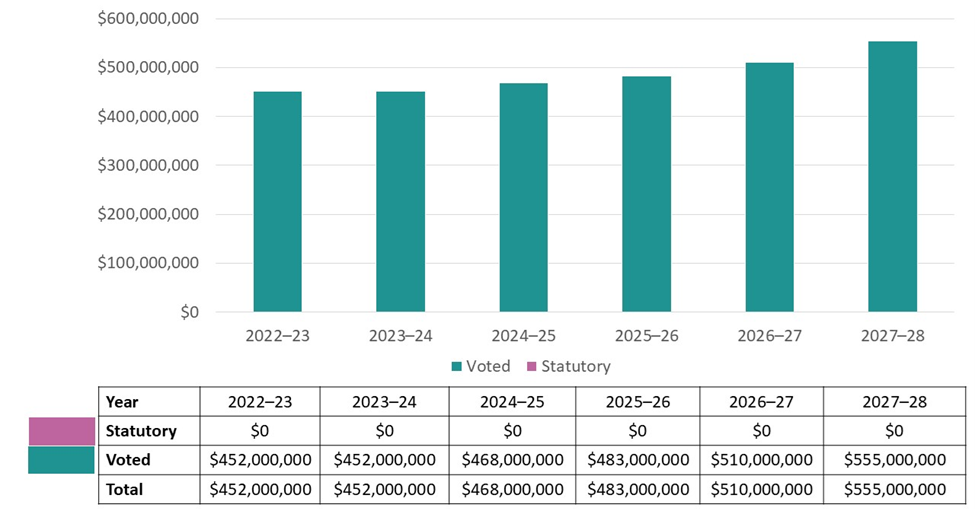
Text description of graph 2
| Fiscal year | Total | Voted | Statutory |
|---|---|---|---|
| 2022-23 | $452,000,000 | $452,000,000 | $0 |
| 2023-24 | $452,000,000 | $452,000,000 | $0 |
| 2024-25 | $468,000,000 | $468,000,000 | $0 |
| 2025-26 | $483,000,000 | $483,000,000 | $0 |
| 2026-27 | $510,000,000 | $510,000,000 | $0 |
| 2027-28 | $555,000,000 | $555,000,000 | $0 |
Analysis of statutory and voted funding over a six-year period
The Research Support Fund is a tri-agency program administered by SSHRC on behalf of the three federal research funding agencies. Given its unique nature and distinct budget, the results of the program are reported under a separate core responsibility in SSHRC’s Departmental Results Framework and its financial information is presented in a separate spending graph.
Voted funding in 2024-25 and in future years is increasing mainly due to:
- funding received from Budget 2022 for an ongoing increase to the Research Support Fund in support of research security;
- funding received from Budget 2024 for an ongoing increase to core research grants, which included the Research Support Fund.
For further information on SSHRC’s departmental appropriations, consult the 2025-26 Main Estimates.
Future-oriented condensed statement of operations
The future-oriented condensed statement of operations provides an overview of SSHRC’s operations for 2024-25 to 2025-26.
Table 11: Future-oriented condensed statement of operations for the year ended March 31, 2026 (dollars)
Table 11 summarizes the expenses and revenues which net to the cost of operations before government funding and transfers for 2024-25 to 2025-26. The forecast and planned amounts in this statement of operations were prepared on an accrual basis. The forecast and planned amounts presented in other sections of the Departmental Plan were prepared on an expenditure basis. Amounts may therefore differ.
| Financial information | 2024-25 Forecast results | 2025-26 Planned results | Difference (Planned results minus forecasted) |
|---|---|---|---|
| Total expenses | 1,302,871,253 | 1,327,447,814 | 24,576,561 |
| Total revenues | 107,962 | 107,962 | |
| Net cost of operations before government funding and transfers | 1,302,763,291 | 1,327,339,852 | 24,576,561 |
Analysis of forecasted and planned results
Total expenses are expected to increase by approximately 1.9% ($24.6 million). The increase is primarily attributable to funding received from Budget 2024 for the increase in the value of scholarship and fellowship awards and the increase to core research grants. Total forecasted expenses for 2024-25 include a retroactive salary payment related to the ratification of SSHRC’s collective agreement, which was completed in October 2024.
A more detailed Future-Oriented Statement of Operations and associated Notes for 2025-26, including a reconciliation of the net cost of operations with the requested authorities, is available on SSHRC’s website.
Human resources
This section presents an overview of the department’s actual and planned human resources from 2022-23 to 2027-28.
Table 12: Actual human resources for core responsibilities and internal services
Table 12 shows a summary of human resources, in full-time equivalents, for SSHRC’s core responsibilities and for its internal services for the previous three fiscal years. Human resources for the current fiscal year are forecasted based on year to date.
| Core responsibilities and internal services | 2022-23 Actual full-time equivalents | 2023-24 Actual full-time equivalents | 2024-25 Forecasted full-time equivalents |
|---|---|---|---|
| Funding Social Sciences and Humanities Research and Training | 228 | 258 | 275 |
| Institutional Support for the Indirect Costs of Research | 7 | 6 | 6 |
| Subtotal | 235 | 264 | 281 |
| Internal services | 108 | 123 | 137 |
| Total | 343 | 387 | 418 |
Analysis of human resources over the last three years
Actual FTEs have increased over the last three years due to additional funding received for the following programs and initiatives:
- the Canada Biomedical Research Fund
- the scholarships and fellowships for Black Students and postdoctoral researchers
- Research Security
- the Sustainable Agriculture Research Initiative
- the Canada Excellence Research Chairs
- the Canada First Research Excellence Fund
- the Race, Gender and Diversity Initiative
- the transfer of the Networks of Centres of Excellence program’s funds to the New Frontiers in Research Fund
- increases to scholarships, fellowships and core research grants
Table 13: Human resources planning summary for core responsibilities and internal services
Table 13 shows information on human resources, in full-time equivalents, for each of SSHRC’s core responsibilities and for its internal services planned for the next three years.
| Core responsibilities and internal services | 2025-26 Planned full-time equivalents | 2026-27 Planned full-time equivalents | 2027-28 Planned full-time equivalents |
|---|---|---|---|
| Funding Social Sciences and Humanities Research and Training | 273 | 269 | 258 |
| Institutional Support for the Indirect Costs of Research | 6 | 6 | 6 |
| Subtotal | 279 | 275 | 264 |
| Internal services | 136 | 135 | 126 |
| Total | 415 | 410 | 390 |
Analysis of human resources for the next three years
Planned FTEs will decrease over the next three years mainly because two temporary programs will conclude during this period—the Canada 150 Research Chairs and the Canada Biomedical Research Fund.
Corporate information
Departmental profile
Appropriate minister(s):
The Honourable Mélanie Joly, P.C., M.P.
Minister of Industry and Minister responsible for Canada Economic Development for Quebec Regions
Institutional head:
Ted Hewitt, President
Ministerial portfolio:
Innovation, Science and Economic Development
Enabling instrument(s):
Social Sciences and Humanities Research Council Act, R.S.C. 1985, c. S-12
Year of incorporation / commencement:
1977
Departmental contact information
Mailing address:
125 Zaida Eddy Private, 2nd floor
Ottawa ON, K1R 0E3
Canada
Telephone:
1-855-275-2861
Email:
Website(s):
Supplementary information tables
The following supplementary information tables are available on SSHRC’s website:
Information on SSHRC’s departmental sustainable development strategy can be found on SSHRC’s website.
Federal tax expenditures
SSHRC’s Departmental Plan does not include information on tax expenditures.
The tax system can be used to achieve public policy objectives through the application of special measures such as low tax rates, exemptions, deductions, deferrals and credits. The Department of Finance Canada publishes cost estimates and projections for these measures each year in the Report on Federal Tax Expenditures.
This report also provides detailed background information on tax expenditures, including descriptions, objectives, historical information and references to related federal spending programs, as well as evaluations and GBA Plus of tax expenditures.
Definitions
List of terms
- appropriation (crédit)
- Any authority of Parliament to pay money out of the Consolidated Revenue Fund.
- budgetary expenditures (dépenses budgétaires)
- Operating and capital expenditures; transfer payments to other levels of government, departments or individuals; and payments to Crown corporations.
- core responsibility (responsabilité essentielle)
- An enduring function or role performed by a department. The intentions of the department with respect to a core responsibility are reflected in one or more related departmental results that the department seeks to contribute to or influence.
- Departmental Plan (plan ministériel)
- A report on the plans and expected performance of an appropriated department over a 3 year period. Departmental Plans are usually tabled in Parliament each spring.
- departmental result (résultat ministériel)
- A consequence or outcome that a department seeks to achieve. A departmental result is often outside departments’ immediate control, but it should be influenced by program-level outcomes.
- departmental result indicator (indicateur de résultat ministériel)
- A quantitative measure of progress on a departmental result.
- departmental results framework (cadre ministériel des résultats)
- A framework that connects the department’s core responsibilities to its departmental results and departmental result indicators.
- Departmental Results Report (rapport sur les résultats ministériels)
- A report on a department’s actual accomplishments against the plans, priorities and expected results set out in the corresponding Departmental Plan.
- full-time equivalent (équivalent temps plein)
- A measure of the extent to which an employee represents a full person-year charge against a departmental budget. For a particular position, the full-time equivalent figure is the ratio of number of hours the person actually works divided by the standard number of hours set out in the person’s collective agreement.
- gender-based analysis plus (GBA Plus) (analyse comparative entre les sexes plus [ACS Plus])
-
Is an analytical tool used to support the development of responsive and inclusive policies, programs and other initiatives. GBA Plus is a process for understanding who is impacted by the issue or opportunity being addressed by the initiative; identifying how the initiative could be tailored to meet diverse needs of the people most impacted; and anticipating and mitigating any barriers to accessing or benefitting from the initiative. GBA Plus is an intersectional analysis that goes beyond biological (sex) and socio-cultural (gender) differences to consider other factors, such as age, disability, education, ethnicity, economic status, geography (including rurality), language, race, religion and sexual orientation.
Using GBA Plus involves taking a gender- and diversity-sensitive approach to our work. Considering all intersecting identity factors as part of GBA Plus, not only sex and gender, is a Government of Canada commitment.
- government priorities (priorités gouvernementales)
- For the purpose of the 2025-26 Departmental Plan, government priorities are the high-level themes outlining the government’s agenda in the most recent Speech from the Throne.
- horizontal initiative (initiative horizontale)
- An initiative where two or more federal departments are given funding to pursue a shared outcome, often linked to a government priority.
- Indigenous business (enterprise autochtones)
- For the purpose of the Directive on the Management of Procurement Appendix E: Mandatory Procedures for Contracts Awarded to Indigenous Businesses and the Government of Canada’s commitment that a mandatory minimum target of 5% of the total value of contracts is awarded to Indigenous businesses, a department that meets the definition and requirements as defined by the Indigenous Business Directory.
- non‑budgetary expenditures (dépenses non budgétaires)
- Non-budgetary authorities that comprise assets and liabilities transactions for loans, investments and advances, or specified purpose accounts, that have been established under specific statutes or under non-statutory authorities in the Estimates and elsewhere. Non-budgetary transactions are those expenditures and receipts related to the government’s financial claims on, and obligations to, outside parties. These consist of transactions in loans, investments and advances; in cash and accounts receivable; in public money received or collected for specified purposes; and in all other assets and liabilities. Other assets and liabilities, not specifically defined in G to P authority codes are to be recorded to an R authority code, which is the residual authority code for all other assets and liabilities.
- performance (rendement)
- What a department did with its resources to achieve its results, how well those results compare to what the department intended to achieve, and how well lessons learned have been identified.
- performance indicator (indicateur de rendement)
- A qualitative or quantitative means of measuring an output or outcome, with the intention of gauging the performance of a department, program, policy or initiative respecting expected results.
- plan (plan)
- The articulation of strategic choices, which provides information on how a department intends to achieve its priorities and associated results. Generally, a plan will explain the logic behind the strategies chosen and tend to focus on actions that lead to the expected result.
- planned spending (dépenses prévues)
-
For Departmental Plans and Departmental Results Reports, planned spending refers to those amounts presented in Main Estimates.
A department is expected to be aware of the authorities that it has sought and received. The determination of planned spending is a departmental responsibility, and departments must be able to defend the expenditure and accrual numbers presented in their Departmental Plans and Departmental Results Reports.
- program (programme)
- Individual or groups of services, activities or combinations thereof that are managed together within the department and focus on a specific set of outputs, outcomes or service levels.
- program inventory (répertoire des programmes)
- Identifies all the department’s programs and describes how resources are organized to contribute to the department’s core responsibilities and results.
- result (résultat)
- A consequence attributed, in part, to a department, policy, program or initiative. Results are not within the control of a single department, policy, program or initiative; instead they are within the area of the department’s influence.
- statutory expenditures (dépenses législatives)
- Expenditures that Parliament has approved through legislation other than appropriation acts. The legislation sets out the purpose of the expenditures and the terms and conditions under which they may be made.
- target (cible)
- A measurable performance or success level that a department, program or initiative plans to achieve within a specified time period. Targets can be either quantitative or qualitative.
- voted expenditures (dépenses votées)
- Expenditures that Parliament approves annually through an appropriation act. The vote wording becomes the governing conditions under which these expenditures may be made.